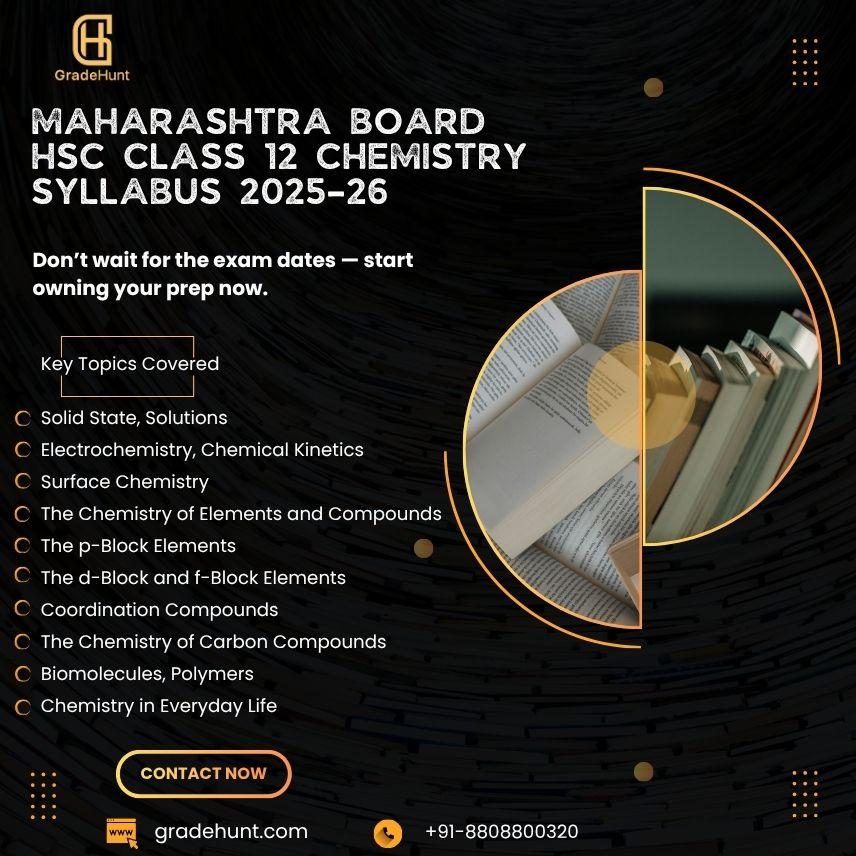
Maharashtra Board HSC Class 12 Chemistry Syllabus 2026-27
Updated for 2026-27: according to board announcements reported in the press, MSBSHSE continues the current SSC and HSC syllabus for 2026-27, with the new syllabus and exam pattern applying from 2027-28. Board exams are provisionally scheduled for February and March 2027; the subject-wise timetable is expected later.
Chemistry is one of the compulsory subjects for those candidates who want to succeed in science and technology streams. The Maharashtra Board HSC Class 12 Chemistry syllabus 2025–26 provides a comprehensive understanding of structure, properties, and alteration in matter. The syllabus is properly framed to combine theoretical knowledge with practical knowledge, thus making it easy for students to study chemical concepts that are practically useful.
This syllabus is divided into several units, each of which covers principal topics in chemistry. Basic concepts such as atomic structure, chemical bonding, organic and inorganic chemistry, and applied aspects are taught to the students. The study of these subjects not only prepares the student for the examinations but also equips them for higher-level studies in chemistry and allied sciences.
Practising past papers is the best way to use this syllabus. Gradehunt’s Maharashtra Board HSC test series gives you chapter-wise and full-syllabus papers with detailed evaluation, so you know where you lose marks before the board exam.
Below is the detailed syllabus with all the units and subtopics:
.
| Unit No. | Unit Name | Chapters and Subtopics |
|---|---|---|
1 | Solid State | - Classification of solids - Crystal lattices and unit cells - Packing in solids - Voids - Density - Imperfection in solids - Electrical and magnetic properties |
2 | Solutions | - Types of solutions - Concentration terms (molarity, molality, normality) - Solubility - Henry's law - Colligative properties (relative lowering of vapour pressure, boiling point elevation, freezing point depression, osmotic pressure) |
3 | Electrochemistry | - Electrolytic and galvanic cells - Electrode potential - Standard electrode potential - Nernst equation - Conductance and conductivity - Electrochemical series |
4 | Chemical Kinetics | - Rate of reaction - Rate determining step - Order and molecularity - Rate constant - Integrated rate equations - Activation energy - Collision theory - Catalysts |
5 | Surface Chemistry | - Adsorption - Adsorption processes - Catalysis - Colloids - Colloid properties - Types of colloids - Emulsions |
6 | The Chemistry of Elements and Compounds | - Extraction, application, and properties of metals (Group 1 and 2 elements) - Preparation and properties of major compounds, hydrides, oxides, halides |
7 | The p-Block Elements | - Group 13 and Group 14 elements - Their properties and compounds - Trends in properties |
8 | The d-Block and f-Block Elements | - General properties - Electronic configuration - Oxidation states - Significant compounds and uses |
9 | Coordination Compounds | - Ligands - Coordination number - Nomenclature - Bonding - Isomerism - Significance and uses |
10 | The Chemistry of Carbon Compounds | - Classification of organic compounds - Nomenclature - Isomerism - Significant functional groups (alkanes, alkenes, alkynes, alcohols, phenols, ethers, aldehydes, ketones, carboxylic acids, esters, amines) - Reaction mechanisms |
11 | Biomolecules | - Carbohydrates - Proteins - Nucleic acids - Vitamins - Enzymes - Their structure and functions |
12 | Polymers | - Types of polymers - Process of polymerisation - Uses of polymers |
13 | Chemistry in Everyday Life | - Chemicals in medicines - Food items - Cleaning agents - Environmental chemistry |
Related Searches

MSBSHSE SSC Exam Admit Card 2027: A Comprehensive Guide
The Maharashtra State Board of Secondary and Higher Secondary Education (MSBSHSE) is one of the most prominent educational boards in India, responsible for conducting the Secondary School Certificate (SSC) examinations for students in the state of Maharashtra. Every year, thousands of students appear for these exams, marking a crucial milestone in their academic journey. For the 2027 SSC exams, the MSBSHSE issues admit cards through schools, and they are essential for students to gain entry into the exam hall.
In this blog, we will delve into the importance of the admit card, provide step-by-step instructions on how to download it, and discuss other vital details related to the exam.
Practising past papers is the best way to use this syllabus. Gradehunt’s Maharashtra Board SSC test series gives you chapter-wise and full-syllabus papers with detailed evaluation, so you know where you lose marks before the board exam.
Mastering the Maharashtra Board 12th English Question Paper: A Comprehensive Guide
The Maharashtra State Board of Secondary and Higher Secondary Education (MSBSHSE) conducts the Higher Secondary Certificate (HSC) examinations annually, marking a pivotal moment in the academic journey of students. For those preparing for the 12th English exam, understanding the question paper structure and content is crucial for achieving success. In this blog, we will delve into the key features of the question paper, the benefits of practicing previous year papers, and provide detailed tips on how to prepare effectively.
Practising past papers is the best way to use this syllabus. Gradehunt’s Maharashtra Board HSC test series gives you chapter-wise and full-syllabus papers with detailed evaluation, so you know where you lose marks before the board exam.