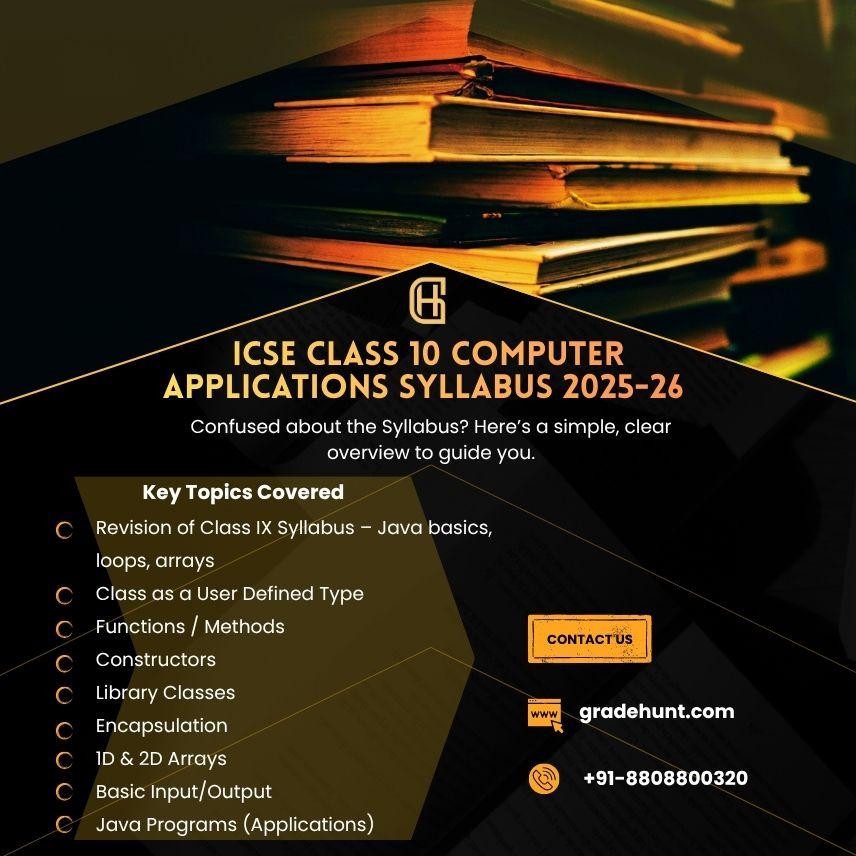
ICSE Class 10 Computer Applications Syllabus 2026-27 | Complete details
Updated for the 2027 ICSE exams: CISCE has published the ICSE 2027 regulations and syllabuses. No chapter deletions have been reported for this subject, and more competency-based questions are expected, but check CISCE's 2027 syllabus and prescribed-book list for your subject.
Computer Applications is an essential subject that introduces students to programming fundamentals and computational thinking. In today's technological times, it is crucial to understand how software works. The ICSE Class 10 Computer Applications syllabus of 2025-26 places strong focus on strengthening students' foundations in Java programming, object-oriented concepts, and problem-solving techniques. It equilibrates theory concepts with practice-oriented programming exercises so that students can develop effective and clean code. The course makes the students ready for advanced computer studies and develops skills very in demand in today's digital economy.
Practising past papers is the best way to use this syllabus. Gradehunt’s ICSE Class 10 test series gives you chapter-wise and full-syllabus papers with detailed evaluation, so you know where you lose marks before the board exam.
Syllabus Table
-
| Unit No. | Unit Title | Topics and Subtopics Covered |
|---|---|---|
1 | Revision of Class IX Syllabus | Basic Java concepts: variables, data types, operators, control statements (if, switch), loops (for, while, do-while), arrays (1D) |
2 | Class as a User Defined Type | Class definition, objects, constructors, method overloading, visibility modifiers, this keyword, local vs instance vs class variables |
3 | Functions / Methods | Definition, method signature, return types, parameter passing, recursion basics, static vs non-static methods |
4 | Constructors | Default and parameterized constructors, constructor overloading, difference between methods and constructors |
5 | Library Classes | String, StringBuffer, and Math classes – frequently used methods |
6 | Encapsulation | Creation of data hiding concept, access specifiers (private, public), encapsulation benefits |
7 | 1D and 2D Arrays | Declaration, initialization, traversal, searching, sorting, matrix operations |
8 | Basic Input/Output | Utilising Scanner for input, System.out.print/println for output, simple formatting |
9 | Java Programs (Application of Concepts) | Programming utilising all the above concepts to solve practical problems |