
 Chat on WhatsApp
Prepare for the CBSE Class 10 Social Science board exam 2027 in three stages: read the four NCERT books within CBSE's board scope, drill the question formats the paper really uses, then write full 80-mark papers in four answer-book sections. The paper is on Monday 8 March 2027, 101 days from today, which is enough for all three stages if the reading is done by early January.
Only 34 of the 100 MCQs I sorted from five official CBSE papers were plain questions; the other 66 asked students to order, match, judge statements, read a picture or table, or apply an idea to a case.
TL;DR
- The theory paper is 80 marks: History, Geography, Political Science and Economics carry 20 each, with 5 map marks inside History and Geography.
- Assertion-Reason and put-in-order questions turned up in all five papers I counted, so practise them as formats, not as luck.
- Every table or number-based MCQ was in Economics, and four of the seven ordering MCQs were History timelines.
- Finish NCERT by 3 January, drill formats and maps in January, and write three timed papers before the Maths paper on 17 February.
How is the CBSE Class 10 Social Science paper set for the 2027 exam?
CBSE's 2026-27 curriculum gives 80 marks to the board paper and 20 to internal assessment. History is 18 marks plus 2 for the map, Geography 17 plus 3, and Political Science and Economics 20 each. Our SST chapter-wise weightage post splits these marks by chapter.
By question type, the 80 marks split like this:
- 20 MCQs of 1 mark
- 4 short answers of 2 marks, up to 40 words
- 5 answers of 3 marks, up to 60 words
- 3 case-based questions of 4 marks, up to 100 words
- 4 long answers of 5 marks, up to 120 words
- 5 map marks in two questions: 2 in the History section, 3 in the Geography section
The curriculum also tags marks by skill: 24 for remembering and understanding, 11 for applying, 40 for analysing, evaluating and creating, and 5 for map work. Half the paper, in other words, rewards reasoning over recall.
What is outside the board paper?
Five limits change what you read. Only subtopics 1 to 1.3 of The Making of a Global World are in the board paper. The Age of Industrialisation is for periodic assessment only, and Lifelines of National Economy is tested through map pointing alone. For Globalisation, the board paper covers 'What is Globalisation?' and the factors that enabled it, while Consumer Rights is project work.
The 2026 papers also told students to divide the answer book into four sections and answer each question in its own section. Our note on the section-wise answer book rule explains it. For the optional second exam, read how the two CBSE board exams work in 2027.
So the 2027 paper is 38 questions in four 20-mark sections, built on 20 of NCERT's 22 chapters, and 40 of its 80 marks test analysis.
What do 100 official MCQs show about the question formats?
I sorted every 1-mark MCQ in five official papers by format: the CBSE sample paper 2026-27, the 2026 main paper (set 32/4/1), the 2026 second board exam (32/7/1), 2025 (32/1/1) and 2024 (32/4/1). All five are on CBSE's question paper page. Each paper has 20 MCQs, so there are 100 in all, and each count below was done twice.
- Plain direct question: 34 (6 to 8 in each paper)
- Assertion-Reason: 13 (2 to 4, in every paper)
- Judge two or more listed statements: 11 (1 to 3)
- Match columns or pairs: 9 (1 to 3)
- Picture, painting, cartoon or infographic: 9 (1 to 3)
- Scenario or case to apply: 8 (1 to 3)
- Put events or states in order: 7 (1 or 2, in every paper)
- Table or numbers: 5 (0 to 2)
- Fill in the blank or odd one out: 4 (0 to 3)
Which part of the syllabus does each format come from?
The formats are not spread evenly. All 5 table or number MCQs were in Economics. Of the 7 ordering MCQs, 4 were History timelines and 3 were Geography rankings, such as states by manganese or bauxite output. Pictures came from all four parts: 3 in History, 1 in Geography, 2 cartoons in Political Science and 3 in Economics.
Assertion-Reason came from all four subjects too, and Political Science had one in four of the five papers. This is a count of past papers, not a CBSE rule, but it tells you which skill to practise for each part.
What is a week-by-week plan from now to 8 March 2027?
The 2027 date sheet puts Maths on 17 February, Science on 22 February, English on 26 February and Hindi on 3 March, so Social Science comes last of the five main papers. Sanskrit is on 1 March, and most other second languages, French included, fall between 4 and 6 March.
- Read Economics and Political Science from 27 November to 10 December, making one page of terms per chapter.
- Read Geography from 11 to 24 December, marking every producer-state list and every map place as you go.
- Read History from 25 December to 3 January, building a single timeline for Europe and India.
- Drill one format a day from 4 to 31 January: Assertion-Reason, ordering, matching, pictures, tables, then 20 minutes of map work.
- Write three full 3-hour papers between 1 and 14 February, then check them against the marking scheme.
- Keep 30 minutes a day for maps and timelines while the other papers run, from 15 February until your second-language paper.
- Use the days left before 8 March (four clear days if you take Hindi on 3 March) for one last timed paper and your own notes, and nothing new.
The plan leaves about five weeks for reading, four for formats and maps, and the rest for timed papers and light revision.
How should you study History, Geography, Political Science and Economics?
History: timelines and pictures
Put the events of The Rise of Nationalism in Europe and Nationalism in India on one dated timeline, because every History ordering question asked for a sequence, not a single date. Then go through every picture and caption in the NCERT book. The sample paper showed a procession and asked which movement it was, and the 2026 main paper opened a question with a sixteenth-century Mughal painting.
The History map has 8 named places, such as Champaran, Kheda and Dandi, so learn the event that goes with each place.
Geography: rankings, soils and the map list
Learn producer states in order, not as a set. The 2024 paper asked for manganese states from highest to lowest, 2025 asked for forest categories by area, and the 2026 second exam asked for bauxite states. The 2026 main paper described a soil in an infographic, so know each soil by its look, its location and its crops.
The curriculum's Geography map list names 65 places, including dams, nuclear plants, software parks and ports. Practise them on a blank outline map every week from January.
Political Science: cartoons and Assertion-Reason
Read every cartoon in Democratic Politics II with its caption, since the sample paper and the 2026 main paper each had a cartoon MCQ. For Assertion-Reason, test yourself on cause and effect inside power sharing, federalism and political parties: is the reason true, and does it explain the assertion?
Economics: sums, sectors and credit
Practise small calculations. The sample paper gave a GDP of ₹900 crore, with ₹300 crore primary and ₹400 crore tertiary, so the secondary sector was ₹200 crore. Other papers used an HDI rank table and a Body Mass Index question. Sector questions came as a picture, a person's work or an ownership clue, so learn the definitions well enough to apply them.
Each part has its own drill: timelines and pictures for History, ranked lists and maps for Geography, cartoons and cause-and-effect for Political Science, and sums for Economics.
Where should you get CBSE Class 10 SST study material?
Start with the five books the curriculum prescribes: the four NCERT textbooks (India and the Contemporary World II, Contemporary India II, Democratic Politics II and Understanding Economic Development) and CBSE's Together, towards a safer India Part III. The sample paper cites the NCERT books as sources, so they come first.
Next, take the sample paper and marking scheme from CBSE's academic site, and the past board papers from cbse.gov.in. Our posts on CBSE Class 10 SST past papers and how to use the 2026-27 sample paper show which sets to write first.
NCERT, the curriculum, the sample paper and CBSE's own past papers are enough; a guidebook is optional.
Which mistakes cost marks, going by these papers?
- Revising SST only by rereading. 66 of the 100 MCQs needed a step beyond recall.
- Learning dates without their order. Every paper had at least one ordering question.
- Skipping pictures, cartoons and tables in NCERT. 9 MCQs were built on a visual and 5 on a table or numbers.
- Reading the Age of Industrialisation in depth for the board paper while the 73-place map list is half done.
- Answering in the wrong section of the answer book, which the 2026 papers made compulsory.
- Writing 200 words where the limit is 120 for a long answer or 60 for a 3-mark answer.
Most of these are habits of preparation, and each one shows up as a lost mark in a full paper.
How should you revise and test in the last month?
Write full papers in the real slot: 15 minutes of reading, then 3 hours from 10:30. Answer section by section in the order of the answer book. After each paper, mark the MCQs yourself from the marking scheme and list every wrong one by format, not by chapter.
Long and case-based answers are harder to judge alone. On the Gradehunt CBSE test series you write the paper by hand, upload one PDF, and subject experts check it within 48 hours with step-wise marks and comments. Your first paper is checked free.
Three timed papers, an error list sorted by format, and daily map practice make the last month count.
Tips are good. Marks come from practice.
Write a board-pattern Social Science paper at home and see exactly where you lose marks.
- 1Get an exam-pattern paper
- 2Write it at home, upload one PDF
- 3Checked with marks and remarks in 48 hours
What does a checked Class 10 Social Science answer look like?
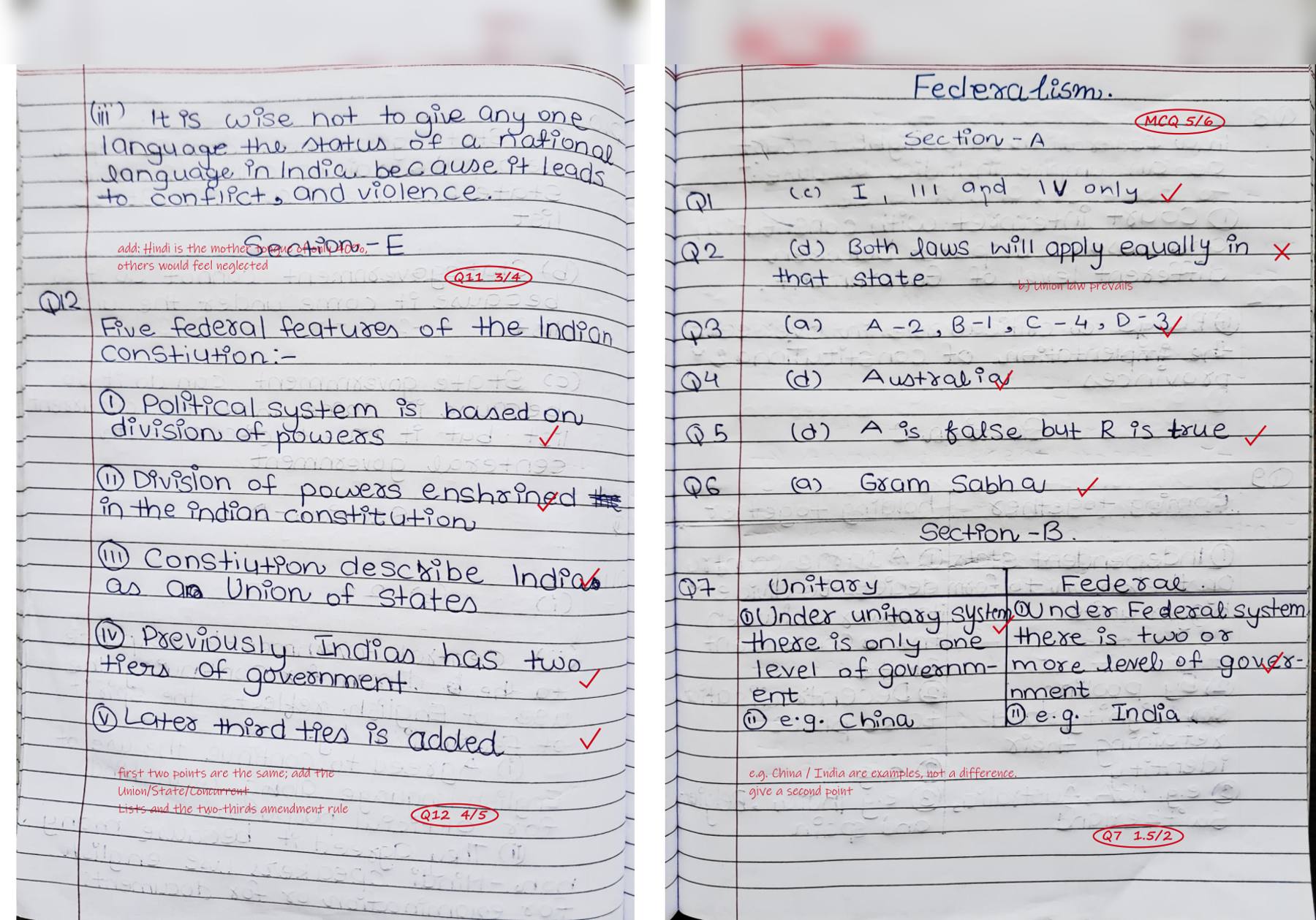
Below are two pages from a Gradehunt Class 10 Social Science test on Federalism, checked in October 2026 (26/30). Each answer gets its marks and a red note on what was missing: two repeated points in Q12, the Union, State and Concurrent Lists, and a second real difference in Q7. Student details are blurred.
Updates to this page
- 27 November 2026: first published.
Finished reading? Now test yourself.
Chapter-wise tests in the latest board pattern, checked with remarks. Test series ₹499/subject.
- 1Get an exam-pattern paper
- 2Write it at home, upload one PDF
- 3Checked with marks and remarks in 48 hours
Not sure which plan fits? Call us free on +91 88088 00320
Get free exam updates by email
Exam dates, study tips and offers. No spam; unsubscribe anytime.
Frequently Asked Questions
Q1.Is NCERT enough for CBSE Class 10 Social Science?
For content, yes. The curriculum prescribes the four NCERT books and one CBSE book, and the sample paper cites NCERT books as sources. What NCERT alone does not give you is practice in formats such as Assertion-Reason, ordering and cartoon questions, so add the sample paper and CBSE's past papers.
Q2.When is the CBSE Class 10 Social Science exam in 2027?
On Monday 8 March 2027, from 10:30 am to 1:30 pm, as per CBSE's date sheet. It comes after Maths, Science, English and your second language; with Hindi on 3 March, that leaves four clear days before it.
Q3.How many MCQs are there in the CBSE Class 10 SST paper?
Twenty, of 1 mark each. In the five official papers I counted, 34 of 100 were plain questions and the rest were formats such as Assertion-Reason (13), listed statements (11), matching (9) and pictures (9).
Q4.How do I prepare for the map question in CBSE Class 10 SST?
Learn the curriculum's list of 73 places, 8 for History and 65 for Geography. The map carries 5 marks, 2 in History and 3 in Geography. Mark the places on a blank outline map once a week from January, and say aloud the event or product that goes with each.
Q5.Which chapters are not in the CBSE Class 10 SST board exam 2027?
The Age of Industrialisation is for periodic assessment only, and Consumer Rights is project work. Lifelines of National Economy is tested through the map only. The Making of a Global World is limited to subtopics 1 to 1.3, and Globalisation to its first two topics.
Q6.How many hours a day should I study Social Science for Class 10 boards?
CBSE gives no figure. With about 100 days left and four other main papers, an hour a day for the first five weeks covers the NCERT reading, then 30 to 45 minutes of format and map practice, with three 3-hour papers in early February.
Related Searches
CBSE Class 10 Mock Tests - Download Free Sample Papers
Download Free Mock Tests for Class 10 CBSE Board Exams. Write and practice with Gradehunt experts and crack your Board exams with 90+ marks in each subject.
Read moreTips to score 90+ marks in CBSE Class 12 English exam
Know the correct approach to score 90+ marks in Class 12 English exam. Know the correct approach to revise grammar, literature and writing techniques
Read more