
 Chat on WhatsApp
To prepare for the CBSE Class 10 Science board exam on 22 February 2027, finish the NCERT textbook first, then drill the three things the paper keeps asking you to produce: labelled diagrams, numericals and balanced chemical equations. In the 2026-27 sample paper and three board papers (2024, 2025 and 2026) I counted 7 compulsory drawing tasks, 14 compulsory Physics questions with a calculation and 7 compulsory questions asking for a chemical equation.
A light ray diagram, an electricity numerical and an ethanol reaction were compulsory in all four papers, so those three skills come before any shortcut.
TL;DR
- The 80-mark paper has three subject sections: Biology 30, Chemistry 25 and Physics 25. Internal assessment adds 20.
- CBSE's design for 2026-27 puts 50% of marks on knowledge and understanding, 30% on application and 20% on analysis and evaluation.
- Plan: NCERT and notebooks until 20 December, section practice until 17 January, full papers until 7 February, then revision.
- Write every answer in its own subject section. The 2026 paper told students not to mix them.
How is the CBSE Class 10 Science paper set for the 2027 exam?
The 2026-27 sample paper carries a CBSE footnote saying the question paper design has not changed this session. This is the layout to practise:
- Section A, Biology: Q1 to Q16, 30 marks. Section B, Chemistry: Q17 to Q29, 25 marks. Section C, Physics: Q30 to Q39, 25 marks.
- 39 questions: 20 of 1 mark (16 MCQs and 4 assertion-reason), 6 of 2 marks, 7 of 3 marks, 3 case-based of 4 marks and 3 long answers of 5 marks.
- Internal choice in 9 places: six whole questions (Q11, 16, 26, 29, 34 and 39) and a sub-part of each case question (Q15, 28 and 38). Each of the three board papers I checked also had 9 choices.
- Internal assessment of 20 marks: periodic assessment 5, multiple assessment 5, portfolio 5 and practical work 5.
The 2024 and 2025 papers grouped questions by type, with MCQs in Section A and case studies in Section E. The 2026 paper switched to subject sections and asked students to divide the answer sheet into Biology, Chemistry and Physics. CBSE's curriculum also keeps Periodic Classification, Evolution and the motor, electromagnetic induction and generator topics for school assessment only, so they stay out of the 80-mark paper.
Science is on Monday 22 February 2027, 10:30 AM to 1:30 PM. For marks by chapter, see our CBSE Class 10 Science chapter-wise weightage; for the optional second exam, read how the two board exams work in 2027.
So the 2027 paper you are preparing for has three subject blocks, 39 questions and an 80-mark theory total.
What did four recent papers ask you to draw, calculate and write?
I went through every question in the 2026-27 sample paper and the Set 1 board papers from three years: 2026 (31/4/1), 2025 (31/1/1) and 2024 (31/4/1). A task counts as compulsory when it sits outside an internal choice or appears in every option. I counted twice, once by reading each question and once by searching the papers for the words draw, equation and calculate.
Diagrams you had to draw
- Sample paper 2026-27: 1 compulsory, Q39 part IV (2 marks), either a myopia-correction diagram or white light splitting in a prism. Optional: electron dot structure of ethanol.
- 2026: 3 compulsory. Q16 asked for stomata or a nephron (both options needed a diagram), Q35 a refraction ray diagram, Q36 a labelled rainbow diagram. Optional: a reflex-action flow chart.
- 2025: 2 compulsory, budding in Hydra (Q22) and convex-mirror ray diagrams (Q31). Optional: butene isomers and a glass-slab ray diagram.
- 2024: 1 compulsory, a lens ray diagram in both options of Q36. Optional: budding in Hydra.
Physics questions with a calculation
- Sample paper: 3 (Q31 current from power, Q35 lens, Q37 circuit), 7 marks in all, with no choice on any of them.
- 2026: 2, work done across 100 V (Q34) and the 5-mark Q39, where option A was a resistor circuit and option B an iron's power plus a monthly electricity bill.
- 2025: 3, lens formula (Q24), a circuit (Q32) and an iron's current rating (Q39). Two more sat in options.
- 2024: 6, including three numerical MCQs on refractive index, resistors and heating.
Chemical equations you had to write
- Sample paper: Q26 in both options (ethanol with acetic acid, or ethanol to ethene to ethane).
- 2026: Q27 in both options (thermit welding, or zinc from zinc blende).
- 2025: Q34 in both options, brine electrolysis in Q37 and the photosynthesis equation in Biology Q38.
- 2024: Plaster of Paris with water (Q27) and ethanol to ethanoic acid (Q28).
The sample paper asks for less drawing than the board papers did: one compulsory diagram against three in 2026. Practise to the board level, not the sample level.
Which question types came back in every paper?
- A light ray diagram was compulsory in all four, whether eye correction, refraction, a rainbow, a convex mirror or a lens.
- An electricity calculation was compulsory in all four, and each paper also had a power, energy or heating sum.
- Ethanol reactions sat in a compulsory question in all four: esterification, oxidation, or dehydration with concentrated sulphuric acid.
- A Mendel pea-plant cross appeared in all four, worth 4, 4, 1 and 3 marks.
- Lens formula numericals came in three of the four; the 2026 set had none. Budding in Hydra was a diagram in two.
Ray diagrams, circuit sums, ethanol reactions and Mendel crosses returned every time, so revise them weekly.
How should you plan the 12 weeks before 22 February 2027?
From 27 November you have 87 days. Split them into four phases:
- Finish NCERT by 20 December. Read each chapter in the 2026-27 syllabus, do the in-text and end-of-chapter questions, and start three notebooks: diagrams, equations and formulas.
- Practise section by section from 21 December to 17 January: one week each for Biology, Chemistry and Physics, then a mixed week. Older papers are grouped by question type, so pull out the questions by subject first.
- Write full 3-hour papers from 18 January to 7 February, about two a week: the sample paper, then the 2026, 2025 and 2024 papers and your school pre-boards.
- Revise from your notebooks from 8 to 21 February. Redraw every diagram, rewrite every equation and solve one numerical of each type.
NCERT, then sections, then full papers, then notebooks: that order leaves two clear weeks for revision before 22 February.
How do you study Biology, Chemistry and Physics for this paper?
Biology, 30 marks
Biology is the largest section, and the board papers set these drawings from it: stomata, the nephron, budding in Hydra and the reflex arc. Draw each from memory and label at least four parts, because the 2026 nephron question asked for exactly that. For genetics, write the full cross with gametes and ratios. Q15 of the sample paper asked for the share of medium-height plants with light violet flowers, and the marking scheme's answer is 0%, because Mendel's traits do not blend. Ecology can bring a sum too. With 10 kJ at the fourth trophic level, the sample paper expected 10,000 kJ at the producers.
Chemistry, 25 marks
Keep one equation list per chapter, balanced and with the condition written over the arrow: concentrated sulphuric acid, nickel catalyst, heat or sunlight. The 2025 paper asked for one essential condition for each of three reactions. In option A of Q29, the sample paper gave two wrong equations to correct, with formulas like AgCl2 and Al2SO4, so check valencies before you balance. Salts recur as well: the 2024, 2025 and 2026 papers each had a question on Plaster of Paris, baking soda or washing soda.
Physics, 25 marks
Write every numerical in three lines: formula, substitution with signs and units, answer with unit. The sample paper's marking scheme gives the lens question one mark per part, taking u as -24 cm to get v = -8 cm and f = -12 cm. In its circuit question the 2 A found in part A feeds part B, so one slip costs both. On ray diagrams, draw arrows on every ray, a dotted normal and the labels the question names.
Each part needs its own method: drawing and crosses in Biology, an equation list in Chemistry and signed working in Physics.
Where do you get CBSE Class 10 Science study material?
- The NCERT Science textbook for Class X, which CBSE prescribes.
- CBSE's 2026-27 curriculum PDF, for the exact syllabus and the topics left to school assessment.
- The sample paper and marking scheme on cbseacademic.nic.in. Our guide on how to use the CBSE Class 10 sample paper 2026-27 explains how to use them.
- Past board papers on cbse.gov.in, or our CBSE Class 10 Science past papers with solutions.
NCERT, the official sample paper and real board papers cover everything this paper tests.
What mistakes cost marks in Class 10 Science?
- Writing an answer in the wrong section. The 2026 paper asked for three sections on the answer sheet.
- Hoping to dodge diagrams through choices. In 2026, Q16 needed a diagram in both options.
- Equations with wrong formulas or no conditions, the very errors the sample paper asked students to fix.
- Dropping the minus sign for a concave lens or mirror, which changes the image position.
- Picking an option before reading both. Each paper had 9 choices, and in 2026 Q33 option A was a fuse calculation while option B was theory on electromagnets.
All five are habits, so build them in every practice paper, not in the last week.
How should you revise and test yourself in the last month?
From 18 January, write each full paper at 10:30 AM, the real start time, after 15 minutes of reading, as the 2026 paper allowed. Check it against the marking scheme and sort every lost mark into four columns: diagram, equation, numerical and concept. Your revision list for February is whichever column grows fastest. Our CBSE Class 10 pre-board preparation guide covers the school round.
Self-checking misses what you cannot see in your own copy. The Gradehunt CBSE test series has Class 10 Science papers in the board pattern: you write by hand, upload one PDF, and a subject expert checks it within 48 hours with marks and comments. Your first paper is checked free.
Tips are good. Marks come from practice.
Write a board-pattern Science paper at home and see exactly where you lose marks.
- 1Get an exam-pattern paper
- 2Write it at home, upload one PDF
- 3Checked with marks and remarks in 48 hours
What does a checked Class 10 Science answer look like?
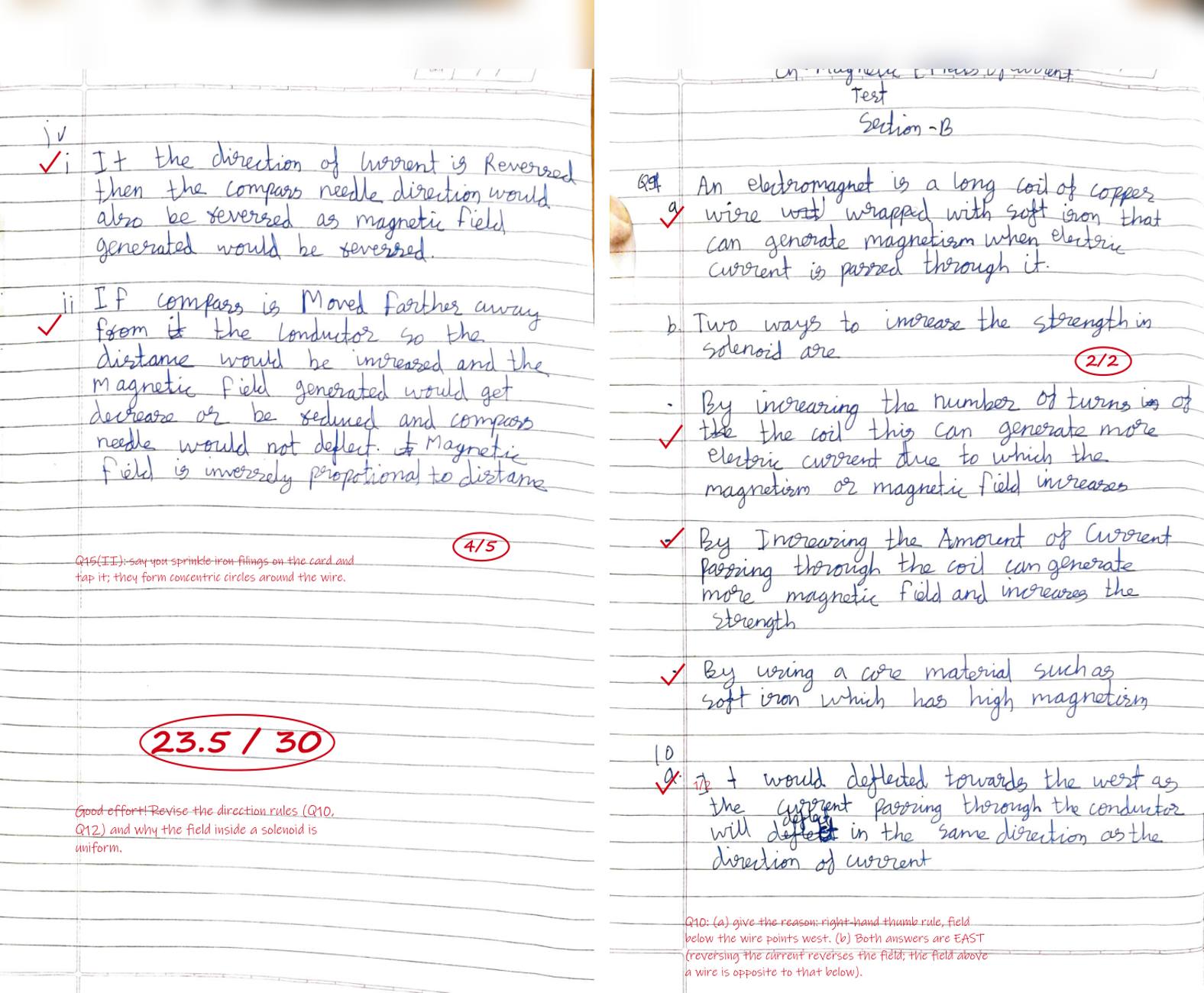
Below are two pages from a Gradehunt Class 10 Science test on Magnetic Effects of Electric Current, checked in October 2026 (23.5/30). Beside the ticks and marks, the checker writes the missing points in red, such as the right-hand thumb rule reason in Q10, and ends with what to revise. Student details are blurred.
Updates to this page
- 27 November 2026: first published.
Finished reading? Now test yourself.
Chapter-wise tests in the latest board pattern, checked with remarks. Test series ₹499/subject.
- 1Get an exam-pattern paper
- 2Write it at home, upload one PDF
- 3Checked with marks and remarks in 48 hours
Not sure which plan fits? Call us free on +91 88088 00320
Get free exam updates by email
Exam dates, study tips and offers. No spam; unsubscribe anytime.
Frequently Asked Questions
Q1.How do I start preparing for the CBSE Class 10 Science board exam 2027?
Start with the NCERT textbook and finish it by about 20 December, keeping separate notebooks for diagrams, equations and formulas. Then practise by section, Biology, Chemistry and Physics, before moving to full 3-hour papers from mid-January. The exam is on 22 February 2027.
Q2.Is NCERT enough for CBSE Class 10 Science?
NCERT is the textbook CBSE prescribes, so it covers the syllabus. Add the 2026-27 sample paper and marking scheme and recent board papers, because they show how CBSE asks: case studies, assertion-reason items and experiment-based questions such as the sample paper's heat-conduction rods.
Q3.Which diagrams are important for Class 10 Science 2027?
Light ray diagrams first: one was compulsory in each of the four papers I counted. After those, practise the nephron, stomata, budding in Hydra, the reflex arc flow chart, eye-defect correction and dispersion through a prism, all of which were asked between 2024 and the 2026-27 sample paper.
Q4.How many numericals come in the Class 10 Science paper?
In my count, compulsory Physics questions with a calculation ranged from 2 (2026) to 6 (2024) per paper, and the sample paper had 3, worth 7 marks. Circuit and power sums came in every paper, and a lens formula question in three of the four.
Q5.Is Periodic Classification in the CBSE Class 10 Science board exam 2027?
No. CBSE's 2026-27 curriculum keeps Periodic Classification of Elements, Evolution and the motor, electromagnetic induction and generator topics for school assessment only. They are not part of the 80-mark board paper, though your school may test them.
Q6.When is the CBSE Class 10 Science exam in 2027?
Monday 22 February 2027, from 10:30 AM to 1:30 PM, as per CBSE's date sheet. The paper is 80 marks and internal assessment adds 20.
Related Searches
CBSE Class 10 Mock Tests - Download Free Sample Papers
Download Free Mock Tests for Class 10 CBSE Board Exams. Write and practice with Gradehunt experts and crack your Board exams with 90+ marks in each subject.
Read moreTips to score 90+ marks in CBSE Class 12 English exam
Know the correct approach to score 90+ marks in Class 12 English exam. Know the correct approach to revise grammar, literature and writing techniques
Read more