
 Chat on WhatsApp
To prepare for the CBSE Class 10 Maths board exam 2027, learn the NCERT chapters, then drill the question types CBSE sets every year: I counted nine that came in Sections B to E of all five recent Maths Standard papers, from 2024 to the 2026-27 sample paper. After that, write full 3-hour papers until 17 February 2027, when Maths Standard and Basic are both held.
A quadratic word problem, a grouped-data question and a heights and distances question took a 5-mark or case-study slot in every one of the five papers.
TL;DR
- Exam: Wednesday 17 February 2027, 10:30 AM to 1:30 PM, 80 marks, plus 20 marks of internal assessment.
- Nine question types appeared in all five papers, among them an irrationality proof, a trigonometric identity and a probability question.
- Three proofs keep coming back: the Basic Proportionality Theorem (BPT), the tangent results, and irrationality of root 2, 3 or 5.
- Plan: chapter gaps in December, question-type drills to mid-January, then five full papers and a final week of formulas.
How is the CBSE Class 10 Maths paper set for the 2027 exam?
CBSE's 2026-27 sample paper for Maths Standard (041) has 38 questions in five sections. Section A has 18 MCQs and 2 assertion-reason questions of 1 mark, B has five 2-mark questions, C six 3-mark, D four 5-mark, and E three case studies of 4 marks split 1, 1 and 2. Two questions each in B, C and D have an internal choice, and so does the 2-mark part of every case study. Calculators are not allowed. The paper notes that the design is unchanged for 2026-27. CBSE's 2026-27 curriculum adds that about half of all board-exam questions are now competency-focused, such as case-based, data and application questions.
The curriculum also says what kind of thinking the 80 marks test:
- Maths Standard: remembering and understanding 43 marks (54%), applying 19 (24%), analysing, evaluating and creating 18 (22%).
- Maths Basic (241): 60 (75%), 12 (15%) and 8 (10%), so Basic leans much more on direct questions. Our post on Maths Standard vs Basic covers the choice.
- Internal assessment, 20 marks: pen-paper tests and multiple assessment 10 (5 + 5), portfolio 5, lab practical 5. The subject-wise split is in our CBSE Class 10 internal assessment post.
CBSE's date sheet of 6 November 2026 puts both Maths papers on 17 February 2027. Under CBSE's two-exam scheme, a student who passes can sit a second exam to improve up to three subjects, Maths included; our post on the two board exams in 2027 explains who qualifies.
The 2027 paper keeps the 38-question, five-section layout, with more than a fifth of the Standard marks set for analysis.
Which question types came in every recent CBSE Maths paper?
I read Sections B to E (the 60 marks of 2- to 5-mark questions) in five Maths Standard papers and noted the type of each question. A type counts if it came as a compulsory question or as one side of a choice. The papers were the 2024 set 30/1/1, the 2025 set 30/1/1, the 2026 main exam set 30/4/1, the 2026 second board exam set 30/7/1, and the 2026-27 sample paper.
In all five papers:
- Quadratic word problem: a 5-marker four times and the 2024 case study (floor tiles).
- Mean, median or mode of grouped data: a 5-marker three times and a case study twice.
- Heights and distances: a 5-marker three times and a case study twice; a kite appears in both the 2026 main paper and the sample paper.
- Arithmetic progression: three case studies, one 5-marker (2024) and one 3-marker (sample paper).
- Pair of linear equations: a word problem or graph in all five; the 2026 second exam made the graph a compulsory 5-marker with a shaded triangle.
- Trigonometric identity: in all five. The sample paper turns it into finding the error in a student's working.
- Irrationality proof: compulsory in three papers, one side of a choice in 2024 and 2026 main.
- Probability in 2 or 3 marks: cards, dice twice, coloured balls, and numbers between 60 and 100.
- Section formula: in all five, though only as a choice in 2024 and inside the coordinate case study in 2026 main.
In four of five: a sector or segment question (area or perimeter), a combination of two solids, and a tangent proof. In three of five: stating and proving BPT, an HCF or LCM application, and a question on the zeroes of a quadratic polynomial (alpha and beta).
One proof came back with a new figure: prove that angle POQ is 90 degrees when a tangent PQ meets two parallel tangents, in 2024 (as a choice, tangents at the ends of a diameter) and in the 2026 second exam.
Source: CBSE Mathematics Standard (041) question papers 2024, 2025 and 2026 (cbse.gov.in) and Sample Question Paper 2026-27 (cbseacademic.nic.in). Gradehunt count, Sections B to E only.
Nine types sat in every paper, so practise each of them in its 5-mark and case-study form before anything rarer. For chapter marks rather than types, see our CBSE Class 10 Maths chapter-wise weightage.
How to prepare for the CBSE Class 10 Maths board exam from December to 17 February?
- Close chapter gaps, 1 to 21 December: finish any NCERT exercise you skipped, unit by unit, and write the three proofs (BPT, the two tangent theorems, an irrationality proof) twice a week from memory.
- Drill question types, 22 December to 18 January: give each week two or three of the nine types and solve every version of them from the five papers, timed. Add the four-in-five types in the last week.
- Write full papers, 19 January to 8 February: one 3-hour paper every three or four days, the five above plus older years, each marked against CBSE's marking scheme the same day.
- Consolidate, 9 to 16 February: one formula sheet, one list of your own errors, and one last full paper no later than 13 February.
That is three weeks of chapters, four of drills, three of full papers and one of revision before the 17 February paper.
How should you study each part of Class 10 Maths?
Algebra (20 marks)
Turn words into an equation before you solve anything. The quadratic 5-markers included a swimming pool strip, a tour budget, a train and two numbers; write the variable, the equation and the reason for rejecting a negative root. For linear equations, practise the graph on graph paper, with two or three points per line, the triangle with the x-axis shaded and its area. For AP, read the case first and decide whether it asks for a term or a sum.
Geometry and circles (15 marks)
The curriculum asks you to prove BPT and both tangent theorems; the other similarity results are stated without proof. Learn each proof as figure, given, to prove, construction and steps. Then practise the trapezium result with a line parallel to the parallel sides, which came in the sample paper and in the 2026 second exam, and the circumscribed-quadrilateral proofs.
Trigonometry (12 marks)
For identities, rewrite everything in sin and cos and work on the side that looks longer. Heights and distances use only 30, 45 and 60 degrees and at most two right triangles, so draw the figure first and label every known length; papers give root 3 as 1.73 when they want a decimal.
Mensuration (10 marks)
Segment questions use only central angles of 60, 90 and 120 degrees. Solids come as two shapes joined, such as a tent or a toy, so decide first whether the question wants surface area (only the outside) or volume (everything).
Statistics, probability, numbers and coordinates (23 marks)
Write the grouped-data formula with every symbol filled in before you calculate; the 2025 and 2026 main papers also asked for a missing frequency. For probability, list the sample space for two dice in full once. Read HCF and LCM word problems for their clue: the biggest equal measure is HCF, the next time things coincide is LCM. In coordinates, check whether the point divides the segment internally or lies on it produced.
Each unit has one habit to build: equations from words, proofs in order, figures first, the right formula, and a full sample space.
Where can you get Class 10 Maths study material?
Start with the books CBSE prescribes in its 2026-27 curriculum:
- The NCERT Class 10 Mathematics textbook, every exercise and example.
- NCERT Mathematics Exemplar Problems for Class 10, for harder versions of the same types.
- CBSE's Guidelines for Mathematics Laboratory and the NCERT laboratory manual, for the 5-mark lab practical in internal assessment.
- CBSE's sample paper with its marking scheme, and past papers with marking schemes on CBSE's question paper page.
Our CBSE Class 10 Maths past year papers post collects the papers from 2020 to 2026 with solutions and download links.
The textbook, the exemplar and five recent CBSE papers cover every question type counted above.
Which mistakes do these papers punish most?
- Skipping the graph method. It was a compulsory 5-marker in the 2026 second exam.
- Learning one tangent theorem only. A tangent proof came in four of five papers, and 2026 main asked a 5-mark tangent question in four parts instead.
- Counting on the choice to dodge a proof. In 2024 and 2026 main the irrationality proof had an HCF or composite-number question as the other option, but the 2026 second exam put irrationality on both sides.
- Leaving out case-study part (iii). It carries 2 of the 4 marks and always has a choice, so read both options before picking.
- Revising only the latest paper. The angle POQ proof skipped 2025 and 2026 main, then came back.
Most of these cost a full 5-mark question or a 2-mark case part, not a stray half mark.
How should you revise and test Maths in the last month?
Write the five papers in this order: 2024, 2025, 2026 main, 2026 second exam, then the sample paper closest to the exam. Sit for the full 3 hours with no calculator. I suggest roughly 25 minutes for Section A, 15 for B, 30 for C, 50 for D, 30 for E and the last 30 for checking.
After each paper, mark it against CBSE's marking scheme, and write every lost mark into an error list under its question type. Redo those types two days later.
Self-marking catches a wrong final answer but often misses a lost step, such as no reason given for rejecting a negative root. Gradehunt's CBSE test series has board-pattern Maths papers that you solve by hand and upload as one PDF; subject experts mark each step within 48 hours, and the first paper is checked free.
Five timed papers, each checked the same day, plus an error list by question type, is the last month's work.
Tips are good. Marks come from practice.
Write a board-pattern Maths paper at home and see exactly where you lose marks.
- 1Get an exam-pattern paper
- 2Write it at home, upload one PDF
- 3Checked with marks and remarks in 48 hours
What does a checked Class 10 Maths answer look like?
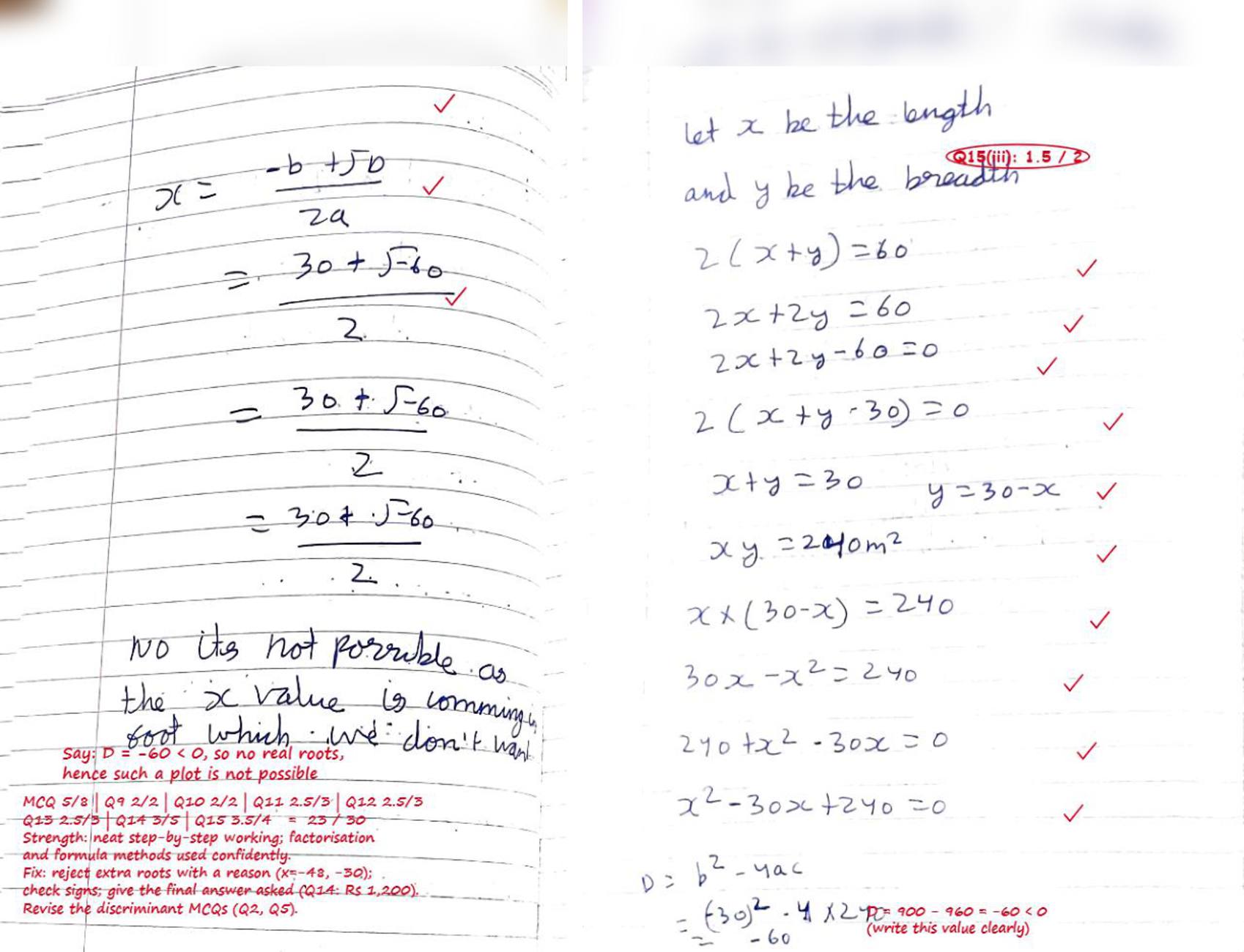
Below are two pages from a Gradehunt Class 10 Maths test checked in October 2026 (23/30). Every step gets a tick, and the red notes give question-wise marks, what was strong and what to fix: reject extra roots with a reason, check signs, give the final answer the question asks for and write the discriminant clearly. Student details are blurred.
Updates to this page
- 27 November 2026: first published.
Finished reading? Now test yourself.
Chapter-wise tests in the latest board pattern, checked with remarks. Test series ₹499/subject.
- 1Get an exam-pattern paper
- 2Write it at home, upload one PDF
- 3Checked with marks and remarks in 48 hours
Not sure which plan fits? Call us free on +91 88088 00320
Get free exam updates by email
Exam dates, study tips and offers. No spam; unsubscribe anytime.
Frequently Asked Questions
Q1.How can I prepare for Class 10 Maths board exam 2027 in under three months?
Split the time into four blocks: close NCERT gaps in December, drill the nine repeat question types to mid-January, write five full papers to early February, then revise formulas and your error list. A student weak in algebra, for example, would give the December block to quadratic and linear equation word problems.
Q2.Is NCERT enough for CBSE Class 10 Maths?
NCERT is the textbook CBSE prescribes, and every question type I counted in the five papers comes from its chapters. CBSE also lists the NCERT Exemplar and lab manuals. Use the exemplar for harder practice and past CBSE papers for timing.
Q3.Which questions repeat in the CBSE Class 10 Maths board exam?
Types repeat more than exact questions. Nine came in all five papers I checked from 2024 to the 2026-27 sample paper, such as a quadratic word problem, grouped-data mean or mode and heights and distances. One proof, angle POQ = 90 degrees with two parallel tangents, came back in 2024 and the 2026 second exam with a different figure.
Q4.When is the CBSE Class 10 Maths exam in 2027?
Wednesday 17 February 2027, 10:30 AM to 1:30 PM, for both Maths Standard (041) and Maths Basic (241), as per CBSE's date sheet of 6 November 2026.
Q5.How many marks is internal assessment in Class 10 Maths?
20 marks: 10 for pen-paper tests and multiple assessment (5 + 5), 5 for the portfolio and 5 for lab practicals. The board paper carries the other 80.
Q6.How many case study questions come in Class 10 Maths?
Three, worth 4 marks each in Section E, with parts of 1, 1 and 2 marks and a choice in the 2-mark part. Topics change: the five papers I counted had case studies on AP, heights and distances, circles, statistics, linear equations and more.
Related Searches
CBSE Class 10 Mock Tests - Download Free Sample Papers
Download Free Mock Tests for Class 10 CBSE Board Exams. Write and practice with Gradehunt experts and crack your Board exams with 90+ marks in each subject.
Read moreTips to score 90+ marks in CBSE Class 12 English exam
Know the correct approach to score 90+ marks in Class 12 English exam. Know the correct approach to revise grammar, literature and writing techniques
Read more