
 Chat on WhatsApp
To prepare for the CBSE Class 10 Hindi board exam on 3 March 2027, read all 17 textbook pieces of your course first, then drill the four grammar topics and every writing format, and write full three-hour papers from mid-January. I counted the 2024, 2025 and 2026 board papers for Course A and Course B: 10 of the 17 pieces in each course were asked all three years, and every Kritika and Sanchayan lesson came every year.
In Hindi, coverage and format are marks you can plan for: no supplementary-reader lesson was ever left out, and 8 of the 20 writing marks in Course A go to format, opening and language.
TL;DR
- Hindi Course A (002) and Course B (085) are both on Wednesday 3 March 2027 at 10:30 am, five days after English.
- Each course has 80 board marks and 20 internal marks. MCQs carry 16 marks; grammar carries 16 marks of one-line written answers.
- Course A used all 17 of its pieces across 2024 to 2026. Course B used 16; Atmatran was never asked.
- The 2026-27 marking scheme counts points: a 2-mark answer needs two, a 4-mark Kritika answer four.
- Plan: lessons until 17 December, grammar and writing until 14 January, one full paper a week after that.
How is the CBSE Class 10 Hindi paper set for the 2027 exam?
Both 2026-27 sample papers open with a CBSE note that the paper design and evaluation have not changed. Course A has 15 questions and Course B 16, each for 80 marks in three hours. The split comes from the 2026-27 curriculum for Hindi A and the curriculum for Hindi B:
- Khand A, unseen reading (apathit bodh): 14 marks in both. Course A gives one prose passage of about 250 words and one poem of about 120; Course B gives two prose passages of about 200 words.
- Khand B, grammar: 16 marks in both. Course A tests sentence types by structure, vachya, pad parichay and alankar. Course B tests padbandh, sentence transformation, samas and muhavare. Each topic has five questions and you answer four.
- Khand C, textbooks: Course A 30 (Kshitij 22, Kritika 8). Course B 28 (Sparsh 22, Sanchayan 6).
- Khand D, writing: Course A 20 (paragraph 6, letter 5, resume or email 5, advert or message 4). Course B 22 (paragraph 5, formal letter 5, notice 4, advert 3, email or short story 5).
How many marks are MCQs, and what kind?
Sixteen in both courses: three in each unseen passage and five in each textbook extract. I sorted the 16 MCQs in each 2026-27 sample paper by type. Course A has 4 assertion-reason, 4 where you pick the right combination of statements and 8 direct questions. Course B has 4, 3 and 9.
In 2024 Course A's objective section had 44 sub-questions, of which you answered 40, half the paper, and grammar was multiple choice. Since 2025 you write grammar answers.
The other 20 marks are internal: periodic assessment, multiple assessment, portfolio, and listening and speaking, 5 each. Our post on CBSE Class 10 internal assessment marks explains how schools award them.
For 2027 the paper keeps 16 MCQ marks, 16 written grammar marks and 20 or 22 writing marks.
Which Hindi lessons came in the last three CBSE board papers?
I read set 1 of each paper (3/1/1 for Course A, 4/1/1 for Course B) for 2024, 2025 and 2026, downloaded from the CBSE question papers page, and noted every lesson a question used.
Source: CBSE Class 10 Hindi A and B board papers 2024 to 2026, set 1. Gradehunt count, checked twice.
Course A: Kshitij and Kritika
- All three years (10 of 17): Netaji ka Chashma, Balgobin Bhagat, Ek Kahani Yah Bhi, Naubatkhane Mein Ibadat, Ram-Lakshman-Parshuram Samvad, Utsah, Sangatkar, Mata ka Anchal, Sana-Sana Hath Jodi and Main Kyon Likhta Hoon.
- Two of three years: Lakhnavi Andaz, Sanskriti, Surdas ke pad, Atmakathya and Yah Danturit Muskan.
- Once: Att Nahin Rahi Hai (2024) and Fasal (2025).
- The 5-mark extracts came from a different lesson every year: prose from Ek Kahani Yah Bhi, Balgobin Bhagat and Naubatkhane Mein Ibadat; poetry from the Parshuram Samvad, Atmakathya and Surdas. The 2026-27 sample paper uses Sanskriti and Att Nahin Rahi Hai.
- Alankar in 2025 and 2026 covered all five figures of speech each year, and both papers asked you to write your own example of utpreksha.
Course B: Sparsh and Sanchayan
- All three years (10 of 17): Bade Bhai Sahab, Diary ka Ek Panna, Tatara-Vamiro Katha, Kabir's sakhi, Meera's pad, Parvat Pradesh Mein Pavas, Top, Harihar Kaka, Sapnon ke-se Din and Topi Shukla.
- Two of three years: Teesri Kasam ke Shilpkar Shailendra, Ab Kahan Doosre ke Dukh se Dukhi Hone Wale, Kartoos, Manushyata and Kar Chale Hum Fida.
- Once: Patjhar Mein Tooti Pattiyan (2024). Never: Atmatran.
- Bade Bhai Sahab was the prose extract in both 2024 and 2025. The 2026-27 sample paper uses Teesri Kasam and Kar Chale Hum Fida.
One judgement call: 2026 Course B asked about "the poem in your textbook that describes nature"; only Parvat Pradesh Mein Pavas fits.
Past papers show spread, not a shortlist. Course A used all 17 pieces in three years and Course B 16, so skipping lessons is a gamble with no support in the papers.
How should you plan the 13 weeks to 3 March 2027?
You have 96 days from 27 November. CBSE's date sheet of 6 November 2026 starts Class 10 papers on 16 February, with Maths on 17 February, Science on 22 February, English on 26 February and Hindi on 3 March. If your other language is Sanskrit, note that it falls on 1 March, so your last Hindi-only stretch is one day, not four.
- Read every piece from 27 November to 17 December: 17 pieces in 21 days. After each, write a five-line summary and two 25-30 word answers.
- Practise five grammar questions a day in the same three weeks.
- Spend 18 December to 14 January on grammar and writing: one grammar topic a week in depth, and one writing task every second day within its word limit.
- Write one full three-hour paper a week from 15 January to 11 February, starting with the 2026-27 sample paper. Spend the next two days fixing what lost marks.
- From 12 February your other papers start, so fit two more full Hindi papers into the free days, and in the last days before 3 March read only your summaries, grammar notes and formats.
The order is lessons first, then grammar and writing, then timed papers fitted around your other board exams.
How do you study each part of the Hindi paper?
Unseen passages and poems
Practise passages on current topics: the 2026-27 Course A sample passage is about Shubhanshu Shukla's space mission of June 2025. In Course A, add one unseen poem a week, as the poem carries 7 marks.
Grammar
Learn each grammar topic as a written answer now. For pad parichay, write the type, gender, number and case or relation of the word. For alankar, keep one example of each of the five figures you can write from memory, since two papers in a row asked for your own utpreksha. Course B students should practise the vigrah and the name of each samas, and use each muhavara in a sentence of their own.
Textbook prose and poetry
Extract MCQs test meaning, so read each whole lesson rather than guide excerpts. For poems, know the poet, the central idea and the meaning of the lines quoted most often; Surdas writes in Braj and Tulsidas in Awadhi, so practise reading the original lines. For 2-mark answers, write two clear points, which is what the marking scheme looks for.
Kritika and Sanchayan
Prepare all three lessons in your reader, because all three were asked every year. Every Course A Kritika question in 2025 and 2026 asked for your own view or argument along with the lesson, such as how we should treat animals after Mata ka Anchal. Write four points for a 4-mark Kritika answer and three for a 3-mark Sanchayan answer.
Writing
Learn each format and write it often: letter openings and endings, resume layout, email subject line, boxed advert. Course A offered one formal and one informal letter as options in all three papers from 2024 to 2026, while Course B asks for a formal letter only.
Each part needs its own skill: speed, accuracy, points or format.
Where should you get Hindi study material?
- NCERT textbooks: Kshitij Part 2 and Kritika Part 2 for Course A; Sparsh Part 2 and Sanchayan Part 2 for Course B. The 2026-27 reprints of Kshitij and Sparsh no longer carry the texts CBSE has dropped.
- CBSE's 2026-27 sample papers and marking schemes for both courses, on the CBSE sample papers page. Our guide on how to use the CBSE Class 10 sample paper 2026-27 shows how to work through them.
- The 2024, 2025 and 2026 board papers, and the second board exam 2026 papers, from CBSE's question paper page.
Older guides may still include texts that are out of the 2027 exam. Course A: Dev's savaiya and kavitt, Chhaya Mat Chhoona, Kanyadan, Stree-shiksha ke Virodhi Kutarkon ka Khandan, Manviya Karuna ki Divya Chamak, and in Kritika, Ehi Thaiyan Jhulni Herani Ho Rama and George Pancham ki Naak. Course B: Bihari's dohe, Madhur-madhur Mere Deepak Jal and Girgit.
NCERT books and CBSE's own papers cover the whole exam.
What mistakes cost marks in Class 10 Hindi?
These come from how the 2026-27 marking schemes split marks:
- Treating writing as content alone. In Course A, 8 of the 20 writing marks are for format, opening or presentation, and language; in Course B, 10 of 22.
- Writing fewer points than marks. The scheme asks for two points in a 2-mark answer, three in a Sanchayan answer and four in a Kritika answer.
- Studying from MCQ grammar books printed before 2025. You now write the answer, so practise writing it.
- Rushing the combination and assertion-reason MCQs. They make up half of Course A's 16 MCQs, and one wrong statement changes the answer.
Most lost Hindi marks are about format and points, which practice under the marking scheme fixes.
How should you revise and test Hindi in the last month?
Write the sample paper and the 2025 and 2026 board papers in three hours each and mark them with the marking scheme, counting points and format marks. Keep a mistakes page and read it before each paper. Our CBSE Class 10 pre-board exam preparation guide covers the school pre-board, and the guide on how to prepare for CBSE Class 10 board exams covers all subjects together.
If you plan to use the second board exam, our post on CBSE Class 10 two board exams 2027 explains the rules.
Three timed papers, strictly marked, make the last-month plan.
The Gradehunt CBSE test series includes Hindi papers you write by hand and upload as one PDF. Subject experts check each copy within 48 hours of upload, with step-wise marks and comments, and your first paper is checked free.
Tips are good. Marks come from practice.
Write a board-pattern Hindi paper at home and see exactly where you lose marks.
- 1Get an exam-pattern paper
- 2Write it at home, upload one PDF
- 3Checked with marks and remarks in 48 hours
What does a checked Class 10 Hindi answer look like?
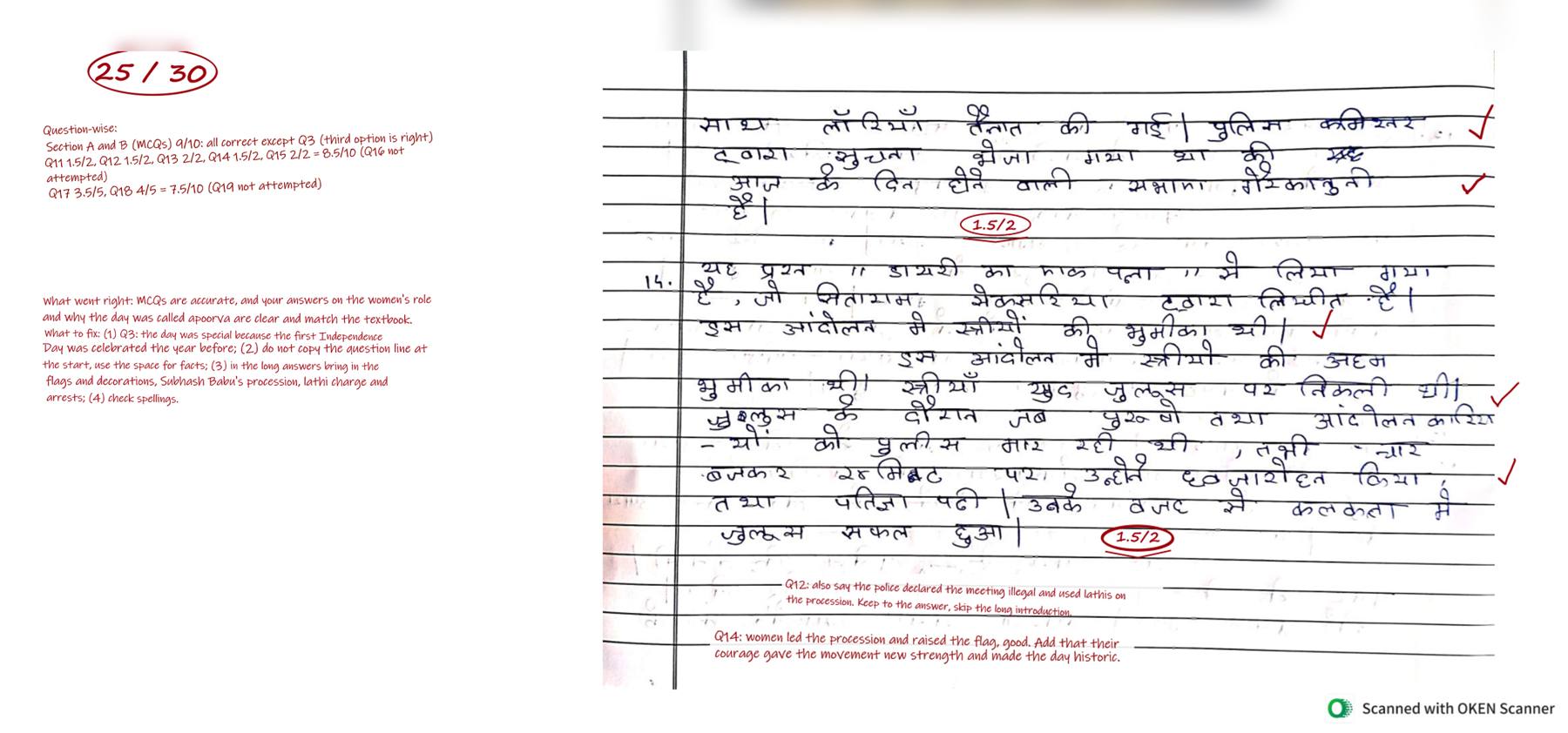
Below are two pages from a Gradehunt Class 10 Hindi B test on Diary Ka Ek Panna, checked in November 2026 (25/30). The left page is the checker's summary: question-wise marks, what went right and four things to fix. The right page shows the notes beside the answers, such as adding that the police used lathis on the procession. Student details are blurred.
Updates to this page
- 27 November 2026: first published.
Finished reading? Now test yourself.
Chapter-wise tests in the latest board pattern, checked with remarks. Test series ₹499/subject.
- 1Get an exam-pattern paper
- 2Write it at home, upload one PDF
- 3Checked with marks and remarks in 48 hours
Not sure which plan fits? Call us free on +91 88088 00320
Get free exam updates by email
Exam dates, study tips and offers. No spam; unsubscribe anytime.
Frequently Asked Questions
Q1.When is the CBSE Class 10 Hindi exam in 2027?
Hindi Course A (002) and Course B (085) are both on Wednesday 3 March 2027, from 10:30 am to 1:30 pm, as per CBSE's date sheet of 6 November 2026. English is on 26 February and Sanskrit on 1 March, so the gap before Hindi depends on your other language.
Q2.What is the difference between Hindi A and Hindi B in Class 10?
Course A uses Kshitij and Kritika and tests vachya, pad parichay, sentence types and alankar. Course B uses Sparsh and Sanchayan and tests padbandh, sentence transformation, samas and muhavare. Both are 80 + 20 marks; Course B has one more writing task and two fewer textbook marks.
Q3.How many MCQs are in the CBSE Class 10 Hindi paper?
Sixteen marks of MCQs in both courses: three in each unseen passage and five in each textbook extract. In the 2026-27 Course A sample paper, eight of the 16 are assertion-reason or statement-combination questions.
Q4.Which Kritika lessons are in the CBSE Class 10 syllabus for 2027?
Three: Mata ka Anchal, Sana-Sana Hath Jodi and Main Kyon Likhta Hoon. Ehi Thaiyan Jhulni Herani Ho Rama and George Pancham ki Naak are not examined. All three lessons were asked in the 2024, 2025 and 2026 board papers, and you answer two of three for 8 marks.
Q5.Can I skip some Hindi chapters for the Class 10 board exam?
No. In my count of the 2024 to 2026 board papers, Course A used all 17 of its pieces and Course B 16 of 17. A lesson missing one year often came back the next, as Lakhnavi Andaz did in 2026.
Q6.How are writing tasks marked in CBSE Class 10 Hindi?
Each task has marks for format or opening, content and language. A Course A letter, for example, gets 1 for format, 3 for content and 1 for language. Across Course A's four writing tasks, 8 of 20 marks are not for content.
Related Searches
CBSE Class 10 Mock Tests - Download Free Sample Papers
Download Free Mock Tests for Class 10 CBSE Board Exams. Write and practice with Gradehunt experts and crack your Board exams with 90+ marks in each subject.
Read moreTips to score 90+ marks in CBSE Class 12 English exam
Know the correct approach to score 90+ marks in Class 12 English exam. Know the correct approach to revise grammar, literature and writing techniques
Read more