
 Chat on WhatsApp
To prepare for the CBSE Class 10 English board exam on 26 February 2027, study all 28 texts in First Flight and Footprints Without Feet, practise the three grammar formats CBSE uses, and write timed letters, analytical paragraphs and two-text answers. I counted five recent CBSE papers, the 2026-27 sample paper and four board sets from 2024 to 2026, and every one of the 28 texts appeared at least once.
In these papers no chapter was safe to skip, and 18 of the 40 rubric-marked writing marks went to format, organisation, expression and accuracy rather than content.
TL;DR
- The board paper is 80 marks in 3 hours: Reading 20, Grammar and Writing 20, Literature 40. Your school adds 20 internal marks.
- All 10 options in Question 10 across the five papers asked about two texts together.
- Each board set had 5 fill-in or choose-the-word items, 4 find-the-error items and 3 reported-speech items in grammar.
- You have 13 weeks from 27 November: finish the texts by late December and write full papers from mid-January.
How is the CBSE Class 10 English paper set for 2027?
CBSE has not changed the English Language and Literature (code 184) design for 2026-27, and the sample paper says so in its footer. The paper has 11 questions in three sections:
- Section A, Reading (20 marks): Q1 is a discursive passage of 400-450 words and Q2 a case-based factual passage of 200-250 words with a chart or data, 10 marks each.
- Section B, Grammar (10 marks): Q3 has 12 one-mark items and you answer any 10, on determiners, tenses, modals, subject-verb concord and reported speech.
- Section B, Writing (10 marks): Q4 is a formal letter and Q5 an analytical paragraph, each in 100-120 words, with a choice of two in each.
- Section C, Literature (40 marks): one prose or drama extract (Q6) and one poetry extract (Q7) of 5 marks each, four of five 40-50 word answers from First Flight (Q8), two of three from Footprints Without Feet (Q9), and one 100-120 word answer from each book (Q10 and Q11).
Count the choices and the paper prints 120 marks of questions for the 80 you answer. Add up the word limits and you write 640 to 780 words of connected English in Sections B and C, before the short reading answers. So I treat this as a writing-speed paper as much as a reading one.
The other 20 marks are internal: pen-paper test 5, multiple assessment 5, portfolio 5, and listening and speaking 5. The listening and speaking part is assessed by your teacher in school, and our post on CBSE Class 10 internal assessment marks shows how the full 20 are awarded.
For 2027 you face the same 80-mark design as 2025-26, with choice inside almost every question except reading.
What did five recent CBSE English papers ask?
I went through the 2026-27 sample paper and one set from each recent exam: 2/4/1 (2024), 2/1/1 (2025), 2/2/1 (2026) and 2/7/1 from the 2026 second board exam. The board papers come from the CBSE question paper page and the sample paper from CBSE Academic. Other sets of the same year carry different questions, so read this as a pattern in five papers, not a forecast.
Which literature chapters came up?
- In all five papers: Mijbil the Otter, Madam Rides the Bus, Amanda, The Thief's Story and The Book that Saved the Earth.
- In four: Nelson Mandela: Long Walk to Freedom, A Letter to God, Glimpses of India and A Triumph of Surgery.
- In three: 12 texts. In two: 5 texts.
- Once: The Trees and For Anne Gregory.
All 10 options in Q10 asked you to write about two texts together, such as Lencho and Kisa Gotami on loss (2024 and 2026), or the tiger in A Tiger in the Zoo against the tiger in How to Tell Wild Animals (second exam 2026). And in all five papers, one of the two Q6 extracts came from Footprints Without Feet, not First Flight.
What did grammar and writing look like?
- Grammar: going by each item's instruction, every one of the four board sets had 5 fill-in or choose-the-word items, 4 find-the-error items and 3 reported-speech items. The sample paper had 6, 3 and 3.
- Letters: 4 of the 8 letter options were letters to the editor. The rest went to an RWA, an MLA, a municipal director and a bank.
- Analytical paragraphs: only 1 of 8 options gave numbers (how students travel to school, in percentages). The other 7 gave cues, feature lists or points set out in a table.
Every text mattered in these papers, Q10 rewarded linking two texts, and grammar stayed with three item formats.
How should you study each section of Class 10 English?
Reading
- Read one opinion article of about 400 words a day and write its main idea in one line. The 2026 set 2/2/1 used a passage on the fear of missing out, which is this kind of discursive writing.
- For Q2, read the chart or data first, then the passage, and answer only from what the two give you.
Grammar
- Learn reported speech for statements, questions and commands, with the tense and pronoun changes. Three of 12 items in every board set I counted were reported speech.
- For error correction, read the whole sentence before you fix a word. The sample paper's "Each of the participants in the Science Fair have been given" needs "has", because the subject is "each".
- Use Words and Expressions II, Units 1-4 and 7-11, which the syllabus prescribes, for daily drills.
Writing
- Fix one formal letter layout (sender's address, date, receiver, subject, salutation, body, closing) and use it every time. Format carries 1 of the 5 marks.
- Practise letters to the editor first, then requests and complaints to officials, matching how the eight options split.
- For the analytical paragraph, open with what the input shows, group related points, and close with one line of conclusion. Organisation carries 2 of 5 marks.
- Since 7 of 8 options gave cues, practise turning bullet points into connected sentences, and keep one numeric chart a week so data does not surprise you.
Literature
- Read every text in the NCERT book itself before any summary. Make a one-page sheet per text: characters, theme, two lines worth quoting and one link to another text.
- Build Q10 pairs from the papers: Lencho and Kisa Gotami (faith and loss), Valli and the young seagull (a first step), Amanda and Valli (freedom), The Ball Poem and Mandela (loss and growing up), and the two tiger poems.
- For Q11, prepare how each Footprints character changes or why they act: Hari Singh, Matilda, Bholi, Horace Danby, Griffin and Richard Ebright all appeared in these options.
- For poems, learn the devices and rhyme schemes. The 2024 set asked for a literary device and the 2025 set for a figure of speech and a rhyme scheme.
Each section needs its own drill: data-first reading, three grammar formats, fixed writing layouts and text sheets built for comparison.
How to prepare for CBSE Class 10 English board exam 2027 week by week?
You have 91 days from 27 November 2026 to Friday 26 February 2027, when the English paper runs from 10:30 am to 1:30 pm as per the CBSE date sheet. Maths comes on 17 February and Science on 22 February. Unless you take a skill subject on Thursday 25 February, you get one clear day before English.
- Weeks 1-4 (27 November to 24 December): finish all 28 texts and their one-page sheets, and do three grammar items a day in rotation.
- Weeks 5-7 (25 December to 14 January): write a letter or an analytical paragraph every other day, and four Q8 or Q9 answers daily. At the paper's average pace of 2.25 minutes a mark, aim for about 7 minutes per 3-mark answer.
- Weeks 8-10 (15 January to 4 February): write the 2026-27 sample paper in three hours, then the past board sets, and mark them against the marking scheme. If your school holds pre-boards in these weeks, count them among your full papers.
- Weeks 11-12 (5 to 18 February): write one full paper a week and revise from your sheets. With Maths on 17 February, keep English to short daily sessions.
- Week 13 (19 to 26 February): reread the sheets, the grammar rules and the letter layout. Start no new text.
Our CBSE Class 10 pre-board exam preparation guide covers how to use those school tests.
The plan front-loads reading the texts, then moves to timed writing and full papers from mid-January.
Where can you get study material for Class 10 English?
- NCERT First Flight and Footprints Without Feet: every Section C question comes from these two books.
- Words and Expressions II (Units 1-4 and 7-11) for grammar and writing practice.
- The 2026-27 sample paper and marking scheme. Our guide on how to use the CBSE Class 10 sample paper 2026-27 shows how to work through it.
- Past board papers with solutions on our CBSE Class 10 English past papers page.
- The full chapter list and question design in the CBSE English syllabus PDF, explained in our CBSE Class 10 English syllabus post.
All the material you need is official and free; the rest of the work is writing.
Which mistakes cost marks in Class 10 English?
- Writing two options for one MCQ. The marking scheme gives no marks when more than one option is written.
- Skipping texts. All 28 appeared in the five papers I counted.
- Writing about only one text when Q10 names two. A comparison answer needs both, with a point of contact between them.
- Turning the analytical paragraph into an opinion essay. The content should come from the given input.
- Letting a 40-50 word answer grow to 100 words. The extra time comes out of Q10 and Q11.
Most of these errors are about format and length rather than knowledge, which makes them the easiest marks to recover.
How should you revise and test yourself before 26 February?
The marking scheme rubrics give 22 of 40 marks in the letter, paragraph and literature answers to content. The other 18 go to format, organisation, expression and accuracy. A self-check against the answer key catches content but misses most of those 18, so get some answers marked by someone who follows the rubric.
- Write at least five full papers by hand: the sample paper, then the 2026, 2026 second exam, 2025 and 2024 sets.
- After each paper, list lost marks by section and fix the weakest one before the next paper.
- Redo every Q10 you wrote using a different pair of texts.
Gradehunt's CBSE test series has English papers you write by hand and upload. Subject experts check each copy within 48 hours with step-wise marks and comments, and your first paper is checked free.
Five full papers, each checked on the rubric and followed by one fix, is the test plan I would set for English.
Tips are good. Marks come from practice.
Write a board-pattern English paper at home and see exactly where you lose marks.
- 1Get an exam-pattern paper
- 2Write it at home, upload one PDF
- 3Checked with marks and remarks in 48 hours
What does a checked Class 10 English answer look like?
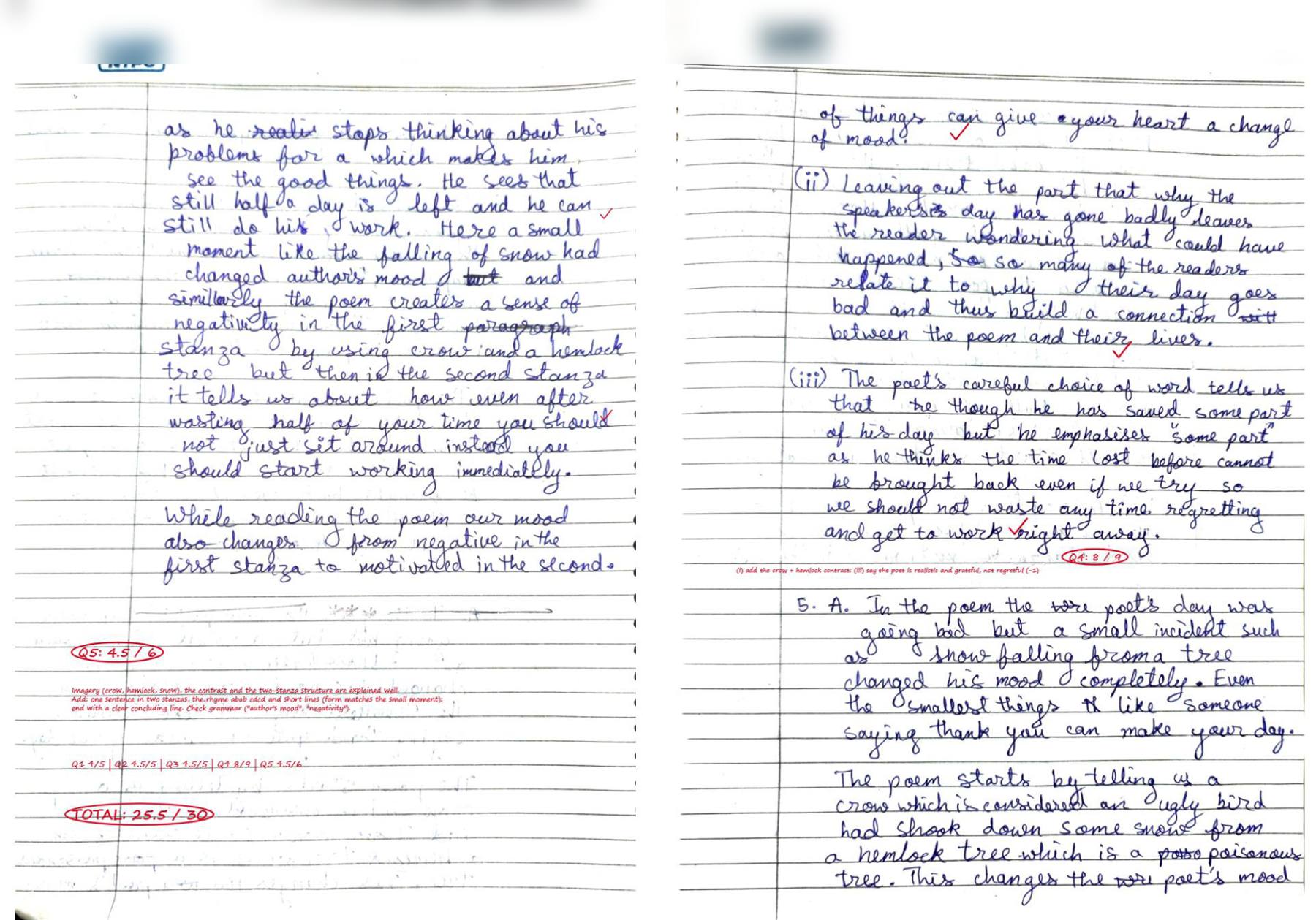
Below are two pages from a Gradehunt Class 10 English test on Dust of Snow, checked in October 2026 (25.5/30). The checker marks each answer, says what was explained well and adds what to fix: the crow and hemlock contrast, a clear concluding line and two grammar slips. Student details are blurred.
Updates to this page
- 27 November 2026: first published.
Finished reading? Now test yourself.
Chapter-wise tests in the latest board pattern, checked with remarks. Test series ₹499/subject.
- 1Get an exam-pattern paper
- 2Write it at home, upload one PDF
- 3Checked with marks and remarks in 48 hours
Not sure which plan fits? Call us free on +91 88088 00320
Get free exam updates by email
Exam dates, study tips and offers. No spam; unsubscribe anytime.
Frequently Asked Questions
Q1.How many marks is the CBSE Class 10 English board exam?
The written paper is 80 marks in 3 hours, and your school adds 20 internal marks for tests, portfolio, multiple assessment, and listening and speaking. Reading carries 20, grammar and writing 20, and literature 40 of the 80.
Q2.Which chapters are most important in CBSE Class 10 English for 2027?
None is safe to skip. In the five papers I counted, all 28 texts appeared at least once. Mijbil the Otter, Madam Rides the Bus, Amanda, The Thief's Story and The Book that Saved the Earth appeared in all five. That is a past count, not a prediction.
Q3.How many grammar questions do I have to answer in Class 10 English?
Ten of twelve, one mark each. In the four board sets I checked, the 12 items split into 5 fill-in or choose-the-word items, 4 find-the-error items and 3 reported-speech items, so practise all three formats.
Q4.Has the CBSE Class 10 English paper pattern changed for 2027?
No. The 2026-27 sample paper states there is no change in the question paper design and assessment pattern. You still get two reading passages, 12 grammar items, a letter, an analytical paragraph and six literature questions.
Q5.When is the CBSE Class 10 English exam in 2027?
Friday 26 February 2027, from 10:30 am to 1:30 pm, for both English Communicative (101) and English Language and Literature (184), as per the CBSE date sheet of 6 November 2026.
Q6.How do I write the analytical paragraph in CBSE Class 10 English?
In 100-120 words, describe what the input shows, group related points, and end with a short conclusion, without adding outside opinions. Organisation carries 2 of the 5 marks. In the board sets I counted, 7 of 8 options gave cues or feature lists, not numbers.
Related Searches
CBSE Class 10 Mock Tests - Download Free Sample Papers
Download Free Mock Tests for Class 10 CBSE Board Exams. Write and practice with Gradehunt experts and crack your Board exams with 90+ marks in each subject.
Read moreTips to score 90+ marks in CBSE Class 12 English exam
Know the correct approach to score 90+ marks in Class 12 English exam. Know the correct approach to revise grammar, literature and writing techniques
Read more