
 Chat on WhatsApp
To prepare for CA Final DT for May 2027, study from ICAI's new material under the Income-tax Act, 2025, give most of your hours to the chapters that carry the most marks (PGBP, trusts, TDS and non-resident taxation), and write a timed computation every week from the first month. I counted that material: 28 chapters on 2,553 pages, with only 211 numbered Test Your Knowledge questions, so past papers and test papers have to carry most of your practice.
Pages are not marks: Advance Rulings runs to 14 pages and took 24 marks in six papers, while Assessment of Various Entities runs to 224 pages and took 16.
TL;DR
- May 2027 is the first CA Final DT attempt under the Income-tax Act, 2025, and ICAI's material covers tax year 2026-27.
- The 28 chapter files run to 2,553 pages: Module 1 has 830, Module 2 424, Module 3 743 and Module 4 556.
- A 19-week learning run means about 120 to 150 pages a week, leaving the last three weeks for revision and full papers.
- On 21 answer sheets checked on Gradehunt CA Final DT tests, October 2025 to October 2026, the average was 52.6% and 3 were under 40%.
How is the CA Final DT paper set for the May 2027 exam?
ICAI's Board of Studies announced on 5 December 2025 that the Income-tax Act, 2025 applies to Final Paper 4 from the May 2027 exam. The Act took effect on 1 April 2026, so the paper tests tax year 2026-27.
The study material is the September 2026 edition. Its initial pages say it follows the Act as amended by the Finance Act, 2026 and the Taxation and Other Laws (Amendment) Act, 2026, with notifications and circulars issued up to 30 September 2026.
In the six ICAI papers from November 2024 to November 2026, Part I carried 30 marks of MCQs and Part II carried 70: a compulsory 14-mark Q1, then any four of Q2 to Q6. Our CA Final DT chapter-wise weightage post splits those 708 printed marks by chapter.
Three hours for 100 marks gives you 1.8 minutes a mark, so Q1 is worth about 25 minutes and Part I about 54.
The law is new for May 2027; the paper's shape is not.
How long is the ICAI study material for CA Final DT?
I downloaded all 28 chapter PDFs from ICAI's study material page for May and November 2027 and counted the pages with two tools; both gave the same totals.
- Module 1, Ch 1 to 8 (basic concepts, exemptions, heads of income, set off, deductions): 830 pages, 51 Test Your Knowledge questions.
- Module 2, Ch 9 to 12 (entities, trusts, tax planning, digital transactions): 424 pages, 31 questions.
- Module 3, Ch 13 to 20 (TDS and TCS, authorities, assessment, appeals, penalties, tax audit): 743 pages, 76 questions.
- Module 4, Ch 21 to 28 (international taxation): 556 pages, 53 questions.
The Test Your Knowledge sections fill 310 of the 2,553 pages. Ch 15, Assessment Procedure, has the most questions (16); Ch 28, Latest Developments in International Taxation, has none.
Which DT chapters give the most marks per page?
Set my page count against the six-paper marks from our weightage post and the reading load looks very different from the scoring load:
- Ch 23, Advance Rulings: 14 pages, 24 marks.
- Ch 22, Double Taxation Relief: 36 pages, 36 marks.
- Ch 10, Trusts and special entities: 124 pages, 92 marks.
- Ch 11, Tax planning and GAAR: 48 pages, 28 marks.
- Ch 3, PGBP, with Q1 counted here: 242 pages, 88 marks.
- Ch 13, TDS and TCS: 207 pages, 80 marks.
- Ch 4, Capital Gains: 202 pages, 26 marks.
- Ch 9, Assessment of Various Entities: 224 pages, 16 marks.
- Ch 8, Deductions from GTI: 136 pages, 4 marks.
A long chapter with few marks still feeds the computations, so do not drop Ch 4, 8 or 9. Read them for the rules a total-income question uses, and spend the saved time on Ch 10, 22 and 23.
Page count tells you how long a chapter takes to read; the marks tell you how long to practise it.
What is a realistic week-by-week plan to May 2027?
ICAI had not notified the May 2027 Final dates when I checked on 27 November 2026. Our CA Final May 2027 study plan works back from 2 May 2027 as a planning date and gives DT more hours than any other paper. From early December that leaves about 22 weeks, which I split like this:
- Weeks 1 to 7, Module 1 (830 pages, about 119 a week): start with PGBP and Capital Gains, 444 pages between them. From week 3, write one company total-income computation a week in the 14-mark Q1 format.
- Weeks 8 to 10, Module 2 (424 pages, about 141 a week): finish trusts first, then use Ch 9's 44 pages of practice questions as computation drills.
- Weeks 11 to 15, Module 3 (743 pages, about 149 a week): TDS and TCS first, then the procedure chapters, building one sheet of time limits as you go.
- Weeks 16 to 19, Module 4 (556 pages, about 139 a week): non-resident taxation and transfer pricing first (346 pages together), then double taxation relief and advance rulings, and the treaty and BEPS chapters last.
- Weeks 20 to 22: revise from your own sheets and write full papers in three hours.
Four learning phases of 3 to 7 weeks, then three weeks of papers, keeps every module inside the plan.
How to prepare CA Final DT module by module?
Module 1: how do you study the total income chapters?
Write every computation with 2025 Act section numbers, as the material now does. PGBP is the longest chapter at 242 pages, yet Capital Gains has more practice questions (13 against 10), so work through both sets. Ch 7 has a new title, Set Off or Carry Forward.
Ch 1 and 2 had no question of their own in the six papers, but their rules turn up inside computations. In five of those six papers, Q1 also asked whether the company should opt for the concessional rates, so finish each practice Q1 with that comparison.
Module 2: how do you handle trusts and entities?
Trusts and special entities took 92 marks in six papers on 124 pages, and our weightage post shows it led the MCQ count too. Learn the registration, application of income and accreted income rules as one connected set.
Ch 9 is the longest practice block in the material: 44 pages and 13 questions. Use it for firm, company and AOP computations rather than reading its 224 pages twice. Ch 11 on GAAR and Ch 12 on digital transactions are short, at 48 and 28 pages.
Module 3: how do you learn TDS, procedure and tax audit?
TDS and TCS take 207 pages and took 80 marks. Make a one-page chart of rates and thresholds under the new section numbers and redo it until you can write it from memory.
The procedure chapters reward structure: state the provision, apply it to the facts, then conclude. Assessment Procedure has 16 practice questions and Appeals and Revision 12; write them out in full. For Ch 20, learn the tax audit report the material now teaches as Form No. 26 under section 63, together with the CA Act ethics points.
Module 4: how do you approach international taxation?
Non-resident taxation (166 pages) and transfer pricing (180) carry the most Module 4 marks. Double Taxation Relief is short, but 15 of its 36 pages are practice questions, so solve them all.
Ch 25 to 28 are theory: BEPS, treaty interpretation, the model conventions and latest developments. Ch 28 has no practice questions, so make your own short notes from its 30 pages.
Each module needs a different method: drills in 1 and 2, charts and structured answers in 3, notes and case practice in 4.
Where should you get CA Final DT study material for May 2027?
Use ICAI's September 2026 material as the base. The Board of Studies wrote it for this exam under the 2025 Act, and its initial pages say only the rules, notifications and circulars it covers, plus the Statutory Update, are relevant at Final level.
ICAI's past papers and suggested answers are still the best practice set, but they were set on the 1961 Act. Rewrite the section numbers as you solve them; our Income-tax Act, 2025 guide for CA Final maps where the sections went.
The material stops at 30 September 2026. ICAI says significant circulars, notifications and amendments up to 31 October 2026 that it does not cover will be hosted as a Statutory Update for May 2027 on the BoS Knowledge Portal, so add that update to your revision sheets once it is out. Our CA Final study material post for May 2027 lists each paper's edition and cut-off date.
ICAI's September 2026 material, its May 2027 Statutory Update and re-numbered past papers cover what May 2027 needs.
What mistakes show up most in CA Final DT answer sheets?
Our data: 21 answer sheets checked on Gradehunt CA Final DT tests, October 2025 to October 2026. Marks are a percentage of each test's total.
- Average: 52.6%.
- Under 40%: 3 sheets; 40-49%: 3; 50-59%: 7; 60% or more: 8.
- Checker comments on 17 sheets mentioned practice or revision on 10, concepts or understanding on 7, and sections, provisions or case laws on 4.
- Too brief, incomplete and calculation errors came up on 2 sheets each; 8 comments were positive.
These are keyword mentions in checkers' remarks, and 21 sheets is a small sample. For comparison, the 32 IDT sheets in the same export averaged 62.4%.
The lesson I take is plain: the most common comment asks for more practice, not more reading. Concept gaps come next, which in DT usually means applying a provision to the facts given. When you quote a section in May 2027, quote the 2025 Act number.
Write more answers than you read chapters, and check each one against the provision.
How should you revise and test for CA Final DT?
- Build one sheet per module: rates, limits and time limits, all under 2025 Act sections.
- Take a chapter test at the end of each learning phase, before you start the next module.
- In weeks 20 to 22, sit three timed DT papers of 100 marks, and stop Part I at about 54 minutes so Q1 gets its 25.
- Get every paper checked, and redo each question where you lost marks within a week.
- Use the last week only for your sheets, Ch 28 notes and Q1 practice. Add no new material.
Our CA Final DT paper analysis shows how long and calculation-heavy the November 2026 paper was, which is why full-paper timing matters.
For DT, the Gradehunt CA Final test series sells chapter-wise, part and full-syllabus papers. Write the computations by hand, scan them into one PDF, and an ex-examiner marks your working notes step by step within 48 hours. The first paper is checked free.
Tips are good. Marks come from practice.
Write a ICAI-pattern paper at home and see exactly where you lose marks.
- 1Get an exam-pattern paper
- 2Write it at home, upload one PDF
- 3Checked with marks and remarks in 48 hours
What does a checked CA Final DT answer look like?
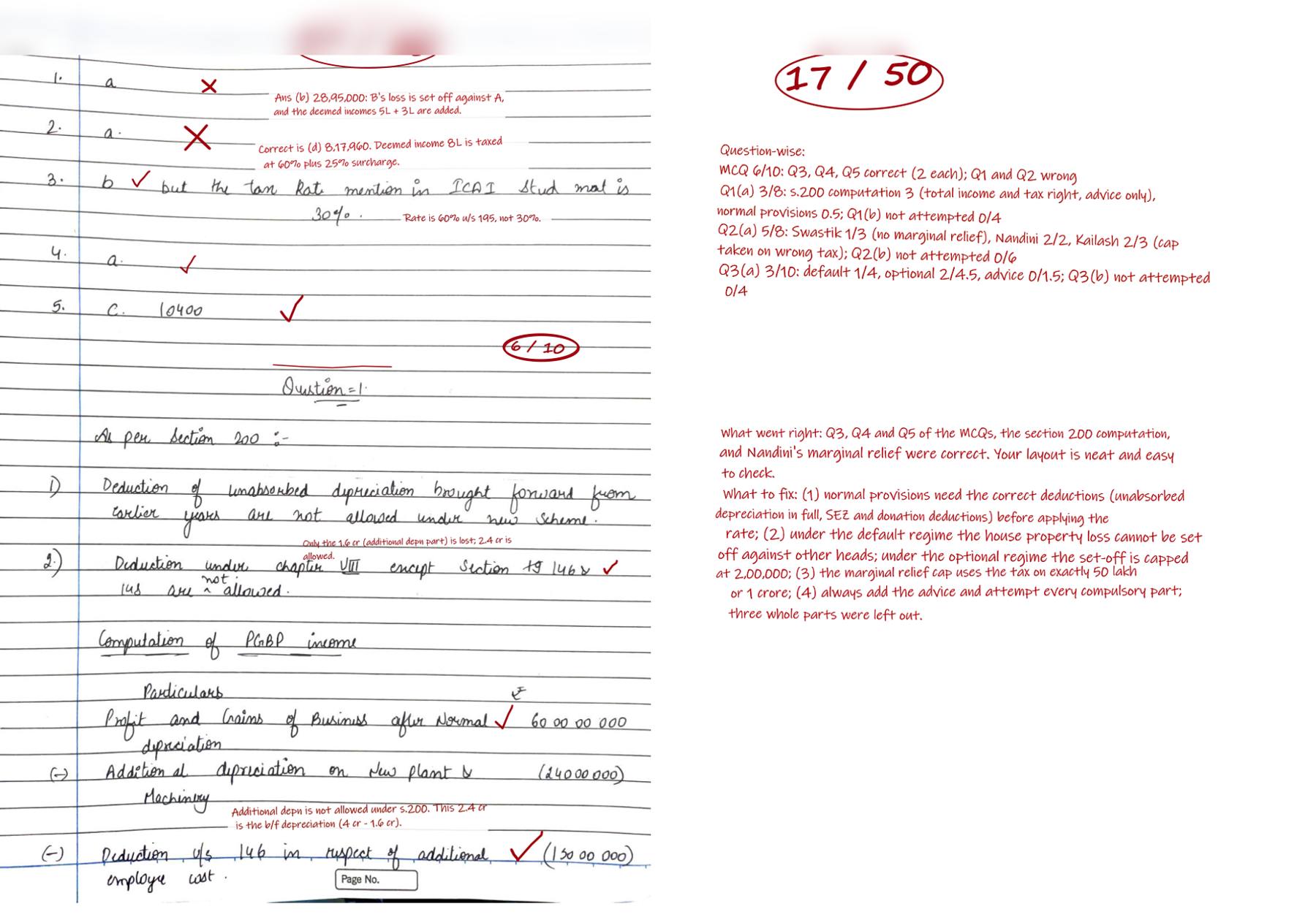
Below are two pages from a CA Final DT test on tax regimes, set-off and marginal relief, checked on Gradehunt (17/50). On the left, wrong MCQs are crossed with the correct answer and working written beside them, and the computation gets a red note on almost every line. On the right is the checker's summary: question-wise marks, what went right and four things to fix, including three parts left unattempted. Student details are blurred.
Updates to this page
- 27 November 2026: first published.
Finished reading? Now test yourself.
ICAI-pattern papers, checked by ex-examiners within 48 hours. Plans from ₹199/subject.
- 1Get an exam-pattern paper
- 2Write it at home, upload one PDF
- 3Checked with marks and remarks in 48 hours
Not sure which plan fits? Call us free on +91 88088 00320
Get free exam updates by email
Exam dates, study tips and offers. No spam; unsubscribe anytime.
Frequently Asked Questions
Q1.Is CA Final DT for May 2027 based on the Income-tax Act, 2025?
Yes. ICAI's announcement of 5 December 2025 applies the 2025 Act to Final Paper 4 from May 2027, and the September 2026 study material covers tax year 2026-27. A student who studied for November 2026 on the 1961 Act has to relearn the section numbers, though many concepts carry over.
Q2.How many pages is the CA Final DT study material for May 2027?
2,553 pages across the 28 chapter files, by my count: Module 1 has 830, Module 2 424, Module 3 743 and Module 4 556. That leaves out initial pages and annexures. PGBP is the longest chapter at 242 pages.
Q3.Which CA Final DT chapters should I study first?
Lead each module with its top-scoring chapter: PGBP, trusts, TDS and TCS, and non-resident taxation. They took the most marks in the six ICAI papers from November 2024 to November 2026, and PGBP also carries the 14-mark Q1. Start Module 4 with transfer pricing beside non-resident taxation.
Q4.Are old CA Final DT past papers useful for May 2027?
Yes, for practice. The questions test the same concepts, but they were set on the 1961 Act, so rewrite each section number under the 2025 Act as you solve. A student who solves the May 2026 paper this way practises the law and the new numbering together.
Q5.Are the ICAI Test Your Knowledge questions enough for CA Final DT?
Not on their own. I counted 211 numbered questions across 28 chapters, and Ch 28 has none. Add ICAI's past papers and suggested answers, then timed test papers that someone checks.
Q6.What is the average score on Gradehunt CA Final DT tests?
52.6% across 21 answer sheets checked from October 2025 to October 2026, with 3 under 40%. The checkers' most frequent comment mentioned practice or revision. It is a small sample, so treat it as a pointer.
Related Searches
CA Salary in India: How much a CA earns in government Job
See how much a CA earns in India, including salary in government jobs and in private firms, and the factors that affect CA pay. Read the full guide.
Read moreChartered Accountant Online Form: A Complete Guide
Get the latest updates regarding the Chartered Accountant online form last date, fees, and documents required at GradeHunt. Never miss a CA exam date!
Read moreCA Full Form: Chartered Accountant, Meaning, Course and Career
CA full form is Chartered Accountant. What a CA does, the three levels of the ICAI course, how long it takes, and how CA differs from CS and CMA.
Read moreCA After Graduation: Eligibility and Direct Entry Route
CA after graduation: commerce graduates need 55%, others 60%. ICAI's Direct Entry rules, provisional registration, the 8-month rule and 2-year articleship.
Read moreCA Course Subjects: A Detailed Guide
Want to prepare for the Chartered Accountancy exams. Know the subjects and correct approach to crack CA exams in first attempt.
Read moreCan I Do B.Com and CA Together? A Complete Guide
Looking for information on B.Com combined with CA? Our experts breakdown the combination, provide the best management tips, and where to study for this in our guide.
Read more